He Hit $4K MRR in 48 Hours With an AI Content Tool

TL;DR: Vitalii Dodonov built Stanley for X, an AI Head of Content that works entirely through text messages, in just 10 days. By coding a $5,000-per-month Twitter ghostwriter's exact system into a $30-per-month AI growth tool, he captured 777 signups and hit $4,000 MRR in 48 hours. This interview reveals his viral launch strategy, clever pricing model, and how his tiny team beat giant tech companies on Product Hunt.
Hello! Who are you, and what business did you start?
My name is Vitalii Dodonov. I am the Co-Founder and CTO of Stan, a platform that helps creators sell digital products and manage their online businesses. At Stan, we have grown to roughly $2.5M in Monthly Recurring Revenue (MRR) (on track for $15M–$30M Annual Recurring Revenue) with a very lean team of around 30 people.
But today, I want to talk about a specific project we recently built and launched called Stanley for X.
Stanley is the world's first AI "Head of Content" for X (formerly Twitter). It is not just another basic AI writing assistant that spits out robotic tweets. It is a smart partner that helps you think, plan, write, and grow your audience.
Our core customers are busy founders, indie hackers, and creators who know they need to post on social media but hate staring at a blank page.
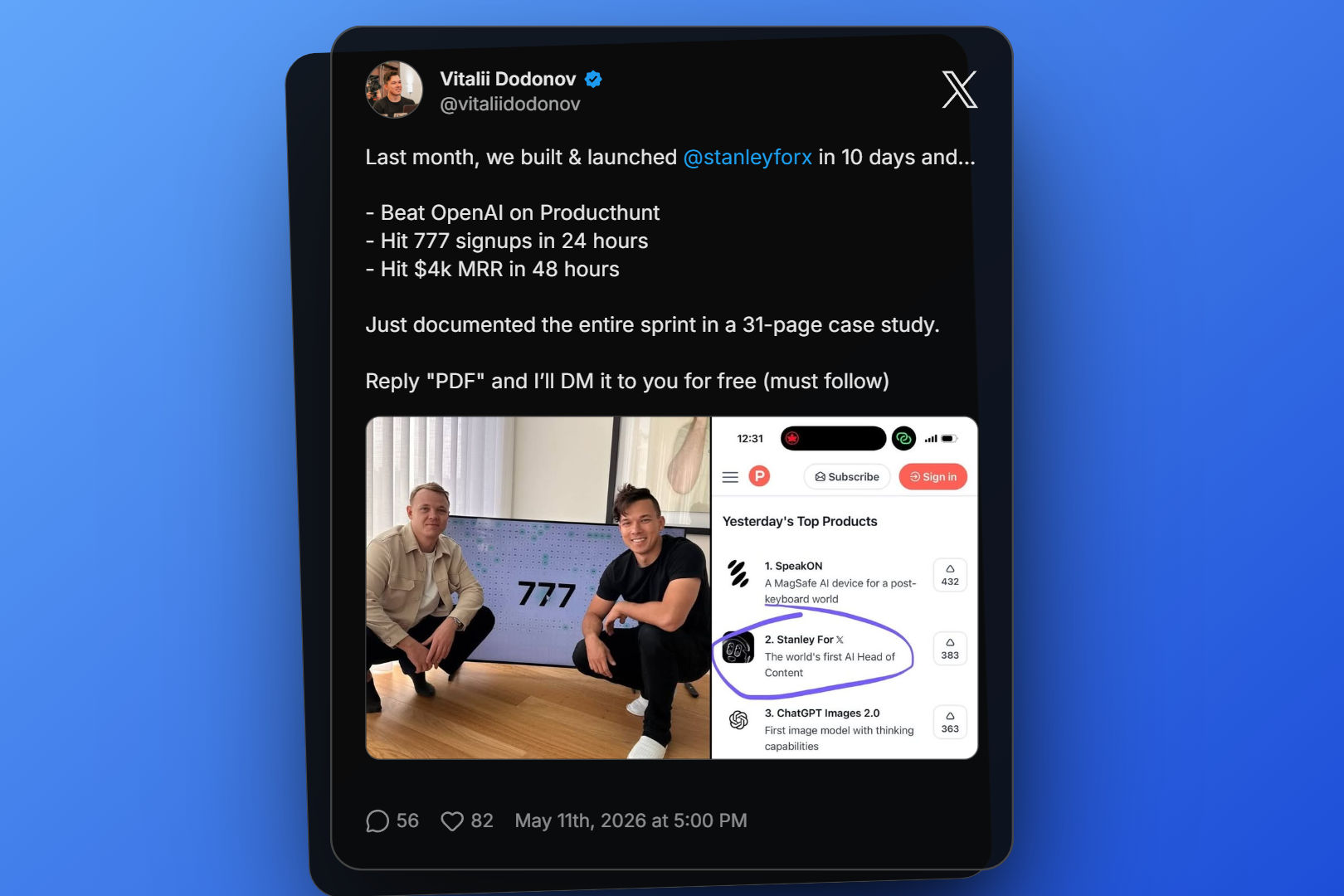
The revenue model is a simple SaaS (Software as a Service) subscription. We charge between $30 and $149 per month depending on the tier. We launched this product in just 10 days. The results were crazy: we got 777 signups in 24 hours and hit $4,000 MRR in just 48 hours. We even beat OpenAI for the #1 spot on Product Hunt that day!
What is your backstory, and how did you come up with the idea for Stanley?
 To understand why we built Stanley, you have to look at a huge problem I was facing myself.
Even though I am the CTO of a massive creator platform, and I have over 60,000 followers on LinkedIn, my personal X account was completely dead. At the start of 2026, I was stuck at just 355 followers.
I knew how to write code, but I had no idea how to write a viral tweet. The daily grind of trying to figure out the X algorithm was a massive waste of my time.
The Validation:
To fix this, I hired a professional ghostwriter named Pascio. I paid him thousands of dollars a month. Over three months, Pascio used a very specific, step-by-step system to take my account from zero to nearly 10,000 followers.
One day, I had a massive "aha" moment. I realized Pascio wasn't using magic. He was using a repeating system. He had specific rules for how to write a hook, how to format a thread, and when to reply to bigger accounts.
I thought: "Could we take the exact systems Pascio uses and code them into an AI?"
If we could do that, we could give everyone the power of a $5,000-a-month ghostwriter for just a fraction of the price. That is when the idea for Stanley for X was born.
Take us through the 10-day sprint. How did you design and build this so fast?
 We treated this like a massive challenge. We gave ourselves exactly 10 days to build it from scratch and launch it.
Here is the exact stack and breakdown of how we did it:
Days 1 to 3: The Brain Dump
Before writing any code, we had to "download" Pascio's brain. He wrote a massive 20-page document that explained every single move he made on my account. This document became the core logic for the AI. We weren't just plugging into a generic ChatGPT prompt; we were building custom logic based on a real human expert.
Days 4 to 7: Building the Stack and the "Secret Sauce"
We had a huge advantage: we already had some existing tech infrastructure from building "Stanley for LinkedIn" earlier. But for X, we wanted to change the game.
Our biggest breakthrough was the user interface (UI). We realized that logging into a website to use an AI tool is annoying. It causes friction.
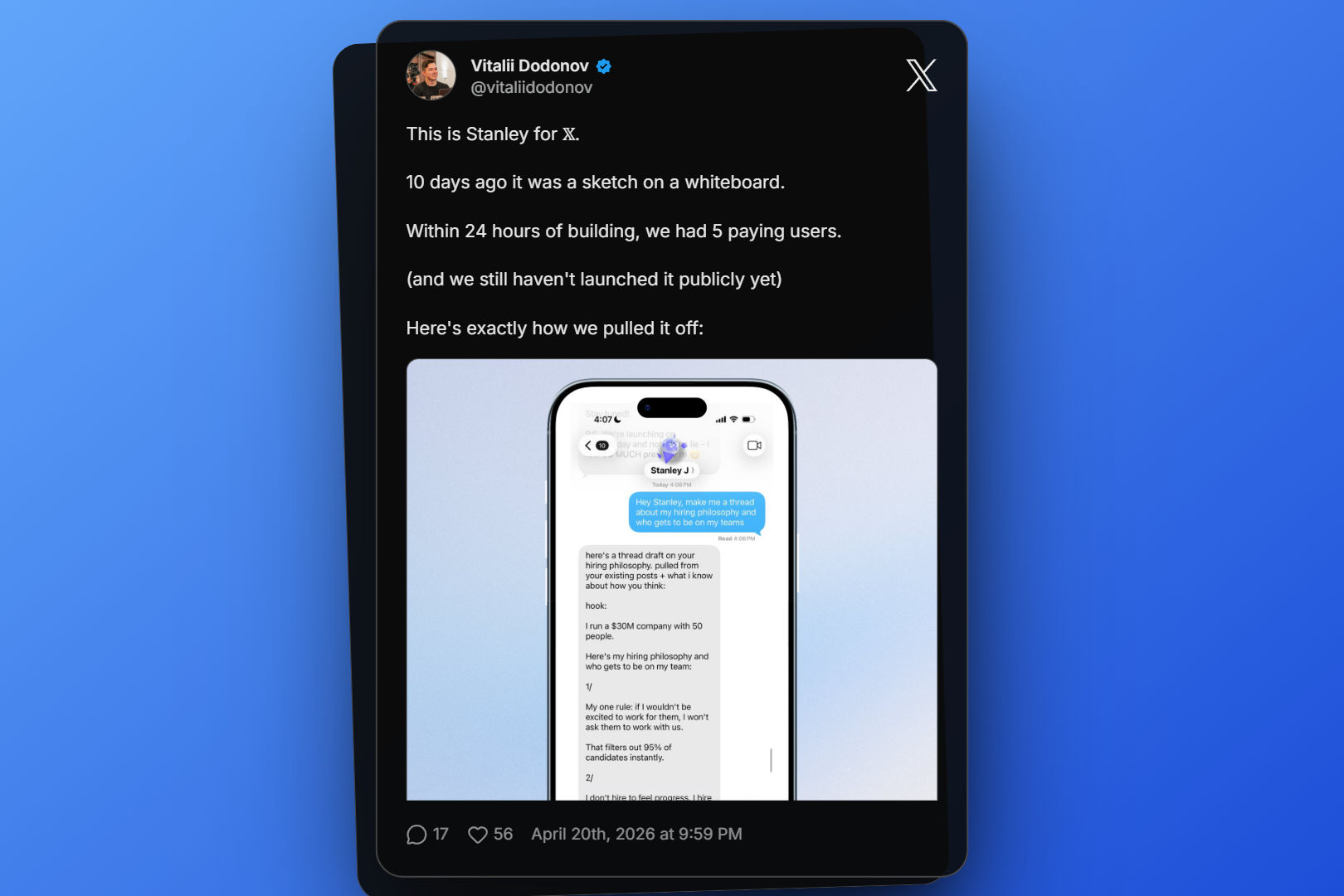
So, our secret sauce was making Stanley work entirely through text messages. You just text a dedicated phone number (like +1 205-422-9431). If you are walking your dog and have a cool idea, you just pull out your phone and text Stanley: "Hey, write a thread about how I built my app in a weekend." Stanley texts you right back with a drafted thread. No apps. No logins. Complete frictionless design.
Days 8 to 10: Marketing Prep
We spent the last few days getting ready to launch. We decided to document the entire 10-day sprint on YouTube and X. We also took Pascio's 20-page document, expanded it to 31 pages, and turned it into a free PDF to use as a marketing tool.
Describe the process of launching. How did you get your very first customers?
 Our launch day was absolutely wild. We launched on April 22, 2026. We were launching on Product Hunt on the exact same day as giant companies like OpenAI and Hugging Face. But we had a plan.
Here is the exact acquisition breakdown of how we got those first 777 signups:
1. The "Reply to get the PDF" Strategy (First Customers)
I used my own personal X account to drive the first massive wave of traffic. I didn't just say, "Here is a link to my new product." Nobody cares about that.
Instead, I told a story. I posted about how I grew my account and built an AI in 10 days. I told people I had a free 31-page PDF case study explaining exactly how we did it.
To get the PDF, people had to:
-
Follow me.
-
Retweet the post.
-
Reply with the word "PDF" or "STANLEY".
This created a massive viral loop. Thousands of people replied. I sent them a Direct Message (DM) with the PDF, and at the end of the PDF, there was a link to try Stanley. These were our very first paying customers.
2. Winning Product Hunt
Because of the hype on X, all those people went over to Product Hunt to support us. The story of a small, fast team beating a giant company like OpenAI was a great narrative. We took the #1 spot with over 400 votes. This gave us huge trust and brought in a second wave of customers who had never heard of me before.
Since launch, what has worked to attract and retain customers?
 Hitting $4,000 MRR in 48 hours is great, but keeping it growing is the real challenge. Here are our main growth channels today:
1. Ecosystem Cross-Selling
Because my main company, Stan, already has over 60,000 active creators, we have a massive pool of warm leads. These creators already trust us to handle their money and storefronts. Offering them an AI tool to help them get more traffic to their stores is an easy "yes."
2. Product-Led Virality
Because Stanley is so easy to use (just sending a text message), our users actually use it every single day. When their follower counts start going up, other people ask them how they are doing it. They naturally share Stanley. Word-of-mouth is our strongest marketing tool.
3. SEO (Search Engine Optimization)
While social media is great for spikes, SEO is important for long-term traffic. We target keywords like "AI Head of Content," "Twitter AI growth tool," and "how to get Twitter followers with AI." We make sure our simple landing page (x.getstanley.ai) is optimized for these search terms so that when founders are looking for a solution to the "blank page" problem, they find us first.
4. Retention through SMS
If you want to keep your MRR high, your product needs to become a daily habit. By living inside the user's text messages, right next to texts from their mom or their best friend, Stanley is impossible to ignore. They never forget they are paying for it because they use it all the time.
What is the pricing and revenue model?
Our revenue model is a pure SaaS subscription. But our pricing strategy is what really makes it work.
We currently price Stanley for X roughly between $30 and $149 per month, depending on what tier and features you want.
The psychology behind this pricing is called "price anchoring." On our landing page and in our marketing, we constantly remind people that a human ghostwriter costs about $5,000 a month. When a user compares paying $5,000 to a human versus paying $30 to an AI that uses the exact same strategies, the $30 feels like a steal.
We also played around with a really fun feature where early users could actually text Stanley and "negotiate" their monthly price directly with the AI! It made the buying process fun and interactive instead of boring.
Because we hit $4K MRR with only 777 initial signups, it shows that a large chunk of people who tried it immediately pulled out their credit cards. They saw the value instantly.
What were your biggest mistakes, and what secrets did you learn?
Mistakes:
If I look back, our biggest mistake early on was trying to make the AI do too much without giving it clear rules. In the first few days of the sprint, Stanley's tweets sounded like generic robot talk. It was boring. We realized that raw AI power is useless without a human framework. We had to go back and force the AI to strictly follow Pascio's rules.
The Big Secret:
The biggest secret to our success is depth over breadth. The AI space is super crowded right now. There are a million "AI writing assistants."
To win, you cannot just build an AI wrapper. You have to find a highly skilled human, map out their exact step-by-step logic, and code that into the software. People are not paying for the AI; they are paying for the codified brain of a $5k/month expert.
What platforms or tools do you use for your business?
We try to keep our stack as simple as possible so we can move fast.
-
Stan Store: We use our own product to process early payments, handle subscriptions, and host our lead magnets. We eat our own dog food!
-
Twilio / SMS APIs: This is the backbone of Stanley. This is what allows users to text Stanley and get a reply instantly without needing to build a complex mobile app.
-
OpenAI APIs: We use the latest language models under the hood, but heavily trained on our custom data.
-
YouTube & X: These are our primary distribution and marketing tools. We turn our coding sessions into documentaries.
What advice do you have for other entrepreneurs who are just starting out?
If you are an indie hacker or founder looking to build your next big thing, here are my top pieces of advice:
1. Validate using an existing audience.
If you have an audience (even a small one), use it. Do not build in secret for six months. Tweet about your idea. Say, "I am thinking about building X, who wants it?" If people say yes, then build it. We offered our PDF case study before the product was even fully finished to make sure people actually cared about the topic.
2. Ship ridiculously fast.
Give yourself a hard deadline. Ten days forced us to cut out all the useless features. We couldn't build a fancy dashboard or a mobile app. We had to just use text messages. And guess what? The text message feature ended up being our best selling point! Constraints force creativity.
3. Be your own customer.
I built Stanley because I needed it. My account was dead, and I had no time to write. When you build a product to solve your own painful problem, you instantly know exactly what features matter, and you know exactly how to market it because you know how you think.
4. Document everything.
People do not buy products anymore; they buy the story behind the product. The story of us working late nights, trying to beat a 10-day clock, and fighting against giant companies on Product Hunt was just as valuable as the code we wrote. Document your journey and share it with the world.
Where can we go to learn more?
-
Try the Product: Go to x.getstanley.ai and text the number on the screen to meet your new Head of Content.
-
Follow my journey on X: @vitaliidodonov
-
Follow Stanley: @stanleyforx
-
Get the Case Study: Go to my X profile and find the original launch tweet to reply and get the full 31-page PDF breakdown.
Vitalii Dodonov
Founder · Stanley
 Canada
This story is compiled from public sources and presented in an interview format for a better reading experience.