How to Get Your First Paying SaaS Customer (The 2026 Founder's Playbook)

TL;DR: To get your first paying SaaS customer, stop wasting time on ads and SEO. Instead, find "workaround users" actively complaining about their problems on Reddit and niche forums. Reach out directly using short, signal-based cold messages. Skip the perpetual free tier to validate real buying intent, and act like a free consultant to manually onboard your first 10 customers. To win early on, you must do things that do not scale.
How to Get Your First Paying SaaS Customer: The Unscalable Playbook
You built the product. You showed it to friends. They said it sounded cool.
Then you launched. And nothing happened.
No signups. No Stripe notifications. Just the sound of your own server humming in the dark.
This is the moment almost every SaaS founder hits the brutal gap between "people seemed interested" and "someone actually paid me." And it's where most early startups die quietly.
Here's the hard truth nobody tells you early enough: your first paying customer will not come from SEO. It won't come from running Facebook ads or submitting to Product Hunt directories. It won't come from a clever launch tweet or a polished landing page with animated gradients.
It will come from a conversation. A real, specific, uncomfortable, deeply personal conversation with someone who has a problem you can solve.
This guide is about how to have that conversation and every strategic step around it.
The Zero-to-One Mindset: Why Traditional Marketing Fails Early SaaS
Most founders approach early customer acquisition the way they were taught to market: cast a wide net, create content, run ads, optimize for conversion. These are perfectly good strategies for a product that already has product-market fit and a marketing budget.
For a pre-revenue SaaS with ten beta users and a half-finished onboarding flow? They're a death sentence.
The Danger of Scalable Channels for Your First 10 Users
Scalable channels like paid ads, SEO content, and email automation share one critical weakness at the zero-to-one stage: they require data to optimize and time to compound. A Google Ads campaign needs conversion history to target efficiently. A content strategy takes six to twelve months to rank. A drip sequence needs a list to send to.
You don't have any of those things yet. And chasing them delays the one activity that will actually generate your first revenue: direct, manual, high-context outreach to a handful of very specific humans.
Y Combinator's Paul Graham put it plainly in his famous essay "Do Things That Don't Scale." The founders who succeed early aren't the ones with the best funnels they're the ones willing to do embarrassingly manual things to get those first customers through the door.
Confusing "Sounds Cool" with "Willing to Pay"
Free beta feedback is almost useless as a revenue signal. When someone can access your tool for free, they have no real skin in the game. They'll say nice things in interviews, ignore your product for three weeks, then come back asking for features you haven't planned yet.
A paying customer behaves completely differently. They read the documentation. They email you at 11pm because they're actually using the thing. Their feedback is sharper, more urgent, and more honest because they're invested.
The goal of your first customer acquisition isn't revenue (not yet). It's getting someone financially committed to your product's success so you can access their real feedback loop.
Step 1: Know Exactly Who You're Hunting
Before you send a single message or write a single email, you need to define your Ideal Customer Profile (ICP) with uncomfortable specificity.
Most early founders define their ICP as something like "marketing teams at B2B SaaS companies." That's not an ICP. That's a TAM.
A real ICP looks like this: "Heads of Content at Series A SaaS companies with 20–80 employees, who recently posted a job listing for a content writer, are currently using Notion for editorial planning, and have complained on LinkedIn about content output inconsistency in the last 60 days."
That level of specificity feels limiting. It isn't. It's what makes your outreach feel eerily relevant rather than generically blasted.
Two Types of Early Users and Why One is Dangerous
Not every early user is worth chasing. After years of community analysis across r/SaaS, Hacker News, and Indie Hackers, a clear pattern emerges: early users fall into two distinct psychological archetypes, and only one of them will help you build a real business.
The Crisis User just had their incumbent tool break. They're panicked. They want something fast, probably free, and they'll abandon you the moment their emergency is resolved. Churn rates for crisis users can hit 60% within the first three months. Their feedback is noise they ask for features they'll never use, demand enterprise-grade security for a solo operation, and vanish when stability returns.
The Workaround User has been duct-taping their workflow together for months. They're using five different tools, a spreadsheet, and pure stubbornness to solve a problem your product could eliminate. They're not in a panic they're exhausted. And they're ready to pay for something that actually works.
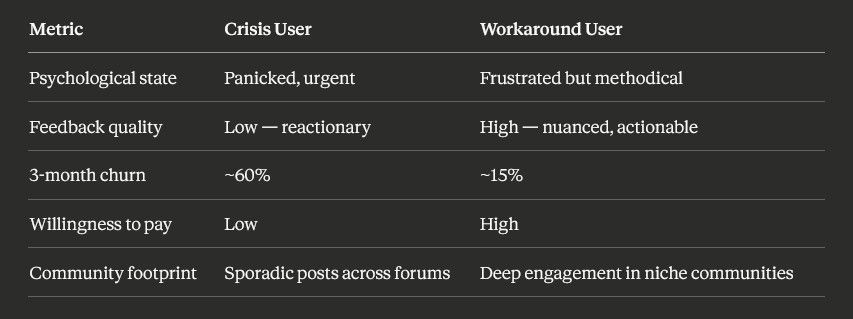 Your outreach, messaging, and product positioning should be aimed entirely at Workaround Users. They already believe the problem is real and worth solving. You just need to convince them you're the better solution.
Finding Warm Leads Disguised as Complaints
Here's a tactical insight competitors consistently miss: your best early customers are probably already complaining about their problem online right now, in public forums and calling it anything except the name of your product category.
Search Reddit and Hacker News not for your product category, but for the pain itself. Instead of searching "invoice software," search "tired of manually tracking client payments." Instead of "CRM tool," search "spreadsheet isn't enough anymore." These complaint threads are gold because the poster has already articulated the problem, quantified their frustration, and crucially asked for help publicly.
That's a buying signal. Treat it like one.
Step 2: The Art of Unscalable Outbound
Once you know who you're looking for, the next challenge is finding them and making contact without sounding like every other founder who's ever slid into someone's DMs with "Hey, I built something you might like."
The 90/10 Reddit Participation Rule
Reddit is one of the highest-concentration discovery pools for early SaaS customers and one of the easiest channels to completely destroy through misuse. Post a product link without context and you'll be banned in minutes, your domain flagged, and your reputation in that community permanently damaged.
The approach that works is almost painfully simple: be genuinely helpful nine times for every one time you softly mention what you've built.
Spend two weeks doing nothing but answering questions in your target subreddits. Give thorough, useful answers that ask for nothing in return. By the time you post a quiet mention of your product framed as "I ran into this problem so much that I built a tool for it" the community already knows you're not a spammer. They respect you. And some of them will click.
Niche Community Targeting (Slack, Discord, MicroConf)
Beyond Reddit, some of the most financially potent communities for B2B SaaS live inside private Slack workspaces and Discord servers. These tend to be smaller, tighter, and filled with operators who are actively building businesses with real budgets.
The trick with private communities is the same as Reddit: arrive first as a contributor. Answer questions. Share frameworks. Give away knowledge that other people charge for. After four to six weeks of consistent participation, you'll have earned the standing to mention your product in context — and you'll have warm leads already familiar with how you think.
Founder DMs: Mini Interviews, Not Pitches
Direct messages work best when they feel like curiosity rather than sales. The framing that consistently gets replies: "I'm building something for [specific problem] and noticed you've dealt with [specific situation]. Would you be open to a 15-minute conversation? I'd love your honest opinion not trying to pitch you."
Most founders are genuinely willing to give feedback, especially to other founders. And a conversation framed as research will almost always run longer than 15 minutes, cover their real pain points in depth, and end with them asking what you're building.
That's when you show them. And that's a very different conversation than a cold pitch.
Step 3: Scripts and Strategies to Secure the First Payment
This is the section most competitors skip entirely. They'll tell you to "reach out to people" or "offer a trial." What they won't tell you is how to handle the psychological weight of actually asking for money.
The Cold Outreach Formula That Actually Works
Effective cold outreach in 2026 is brutally short, painfully specific, and aggressively human. Here's the anatomy:
Subject line (3–5 words, lowercase): noticed something about [company]
The hook (line 1 - about them, not you):
"Saw that you hired three SDRs last month after the Series A close."
The value proposition (line 2 - outcome, not features):
"We help early sales teams cut ramp time from 90 days to 30."
Social proof (line 3 - peer, not logo wall):
"[Similar company at similar stage] cut their onboarding time in half using us in Q1."
The soft ask (line 4 - frictionless):
"Worth a 3-minute Loom showing how they did it?"
Total length: 50–90 words. No attachments. No calendly link in the first message. No "I hope this email finds you well."
The subject line is lowercase because it looks like something a colleague dashed off in a hurry. The hook is about a real signal you identified before writing the email. The ask is low-stakes not "book a 45-minute demo" but "want to see a short video." Every word is a friction-reduction decision.
Structuring the Paid Pilot
For B2B prospects who are interested but hesitant, a paid pilot is often the bridge between "sounds interesting" and a signed agreement. The pilot isn't free that's the entire point. A nominal fee of $200–$500 for a 30-day structured trial accomplishes two things: it filters out uncommitted prospects, and it creates the psychological investment needed to generate serious, actionable feedback.
Structure the pilot with a clear scope, defined success metrics agreed upon upfront, and an explicit exit clause if the product doesn't deliver. This removes the buyer's risk while keeping yours minimal.
A written scope for a pilot might look like:
- Duration: 30 days
- Goal: Reduce time spent on [specific task] by 40%
- Success metric: [User] will run [X process] without needing to touch [incumbent tool]
- Fee: $300 (credited toward first month if they convert)
Arming Your Champion for Internal Politics
In B2B sales, the person you're talking to is rarely the person who signs the check. Even enthusiastic users need to convince a manager, a CFO, or a procurement team. And most of them will forget the important details when asked to justify a software purchase in a meeting.
Give your internal champion a one-pager. Not a polished marketing brochure a plain-text document (seriously, Google Doc is fine) with three things:
- The problem it solves, in their exact language
- What it would cost to continue without it (time, money, frustration)
- One comparable customer with a concrete result
When they share it with their boss, they share it verbatim. You've done their sales job for them.
Step 4: White-Glove Onboarding for Your First Cohort
Getting the customer to sign up is not the finish line. The real work begins the moment they access the product for the first time because this is when the gap between what they imagined and what they're looking at becomes painfully clear.
Doing Things Manually Before Automating
Your first ten customers should feel like they have a dedicated personal account manager because they do. You.
This means personally setting up their account, migrating their data, building their first workflow, and checking in every few days. It's exhausting, unsustainable, and absolutely essential. You're not just delivering a good experience you're learning, in real time, exactly where your product fails and where it delights. That intelligence is worth more than any usability study.
The Cresta story illustrates this beautifully in the extreme. CEO Zayd Enam, unable to get Intuit to sign a vendor agreement with an early-stage startup, took an actual internship at the company. From the inside, he deployed his AI sales coaching software directly to live reps, bypassing procurement entirely. When performance doubled, the enterprise agreement followed naturally. The internship was terminated by addendum to the contract.
You probably won't need to take an internship. But the principle holds: do whatever it takes, manually, to get your product into the hands of the right person delivering a real result.
Capturing the Feedback Loop for Product-Market Fit
After each manual onboarding session, document what confused users, what delighted them, and what they asked for that doesn't yet exist. Create a simple friction log a running spreadsheet with five columns:
User Moment of Confusion What They Said What They Did What This Suggests
After ten customers, patterns will emerge. The same three points of friction will appear repeatedly. The same feature request will surface from unrelated users in the same language. This is your product roadmap, written by the market itself.
Common SaaS Customer Acquisition Mistakes to Avoid
Launching on Directories and Attracting Tire-Kickers
Product Hunt, AppSumo, and BetaList can generate a spike of signups. They will rarely generate sustainable Monthly Recurring Revenue.
The audiences on these platforms are experienced at finding new tools, expert at demanding lifetime deals, and historically poor at converting to paid subscriptions. A Product Hunt #1 launch can feel like validation. Then you look at MRR six weeks later and realize most of those users never logged back in after day one.
Use directory launches for signal gathering, not revenue. If you want your first paying customers, go direct.
Offering the Product for Free Indefinitely
A perpetual free tier is one of the most common traps in early B2B SaaS. It feels generous and growth-oriented. In practice, it attracts a massive cohort of users who were never going to pay anyway.
Free-tier conversion rates in B2B SaaS hover between 2% and 5%. Structured free trials time-boxed, with clear upgrade prompts convert at 10% to 25%. The difference is urgency and qualification. Charge early. Even $29 a month is enough to filter out the noise and start building a revenue feedback loop.
Zapier's early pricing makes this point powerfully. Co-founder Wade Foster charged $100 just to access the beta. The users who paid were highly motivated, deeply invested, and gave extraordinarily useful feedback. The ones who wouldn't pay? They weren't the customers Zapier needed to build for.
Conclusion: The Counterintuitive Path to First Revenue
Acquiring your first paying SaaS customer is not a marketing challenge. It's an empathy challenge.
The founders who crack it fastest are not the ones with the best landing pages or the most aggressive ad budgets. They're the ones willing to have uncomfortable conversations, do things manually that don't scale, charge for their product before it's perfect, and stay intensely focused on a very small, very specific group of people who have a very real problem.
Ignore the directories. Ignore the scalable funnels. Ignore the "launch strategies" that promise traffic spikes with no revenue attached.
Instead: define your Workaround User precisely. Find where they're complaining online. Join those communities and be genuinely useful. Send short, human, signal-based outreach. Offer a paid pilot. Onboard them personally. Ask for feedback constantly. Then do it again.
The first paying customer is the hardest. Everything after that gets to be built on something real.