How to Make Your First $1,000 Online in 2026 (The Real Blueprint)

TL;DR: Making your first $1,000 online in 2026 requires abandoning outdated "passive income" myths and mass-produced AI content. The fastest, most realistic path is to leverage the "Human Premium" by offering outcome-based B2B services, such as simple AI automations, directly to local businesses. If you prefer to work without clients, you can build a "Solution Cabinet" of low-cost digital templates that solve frustrating "annoyance gaps," or use search-based affiliate marketing to target high-intent buyers. Ultimately, success comes down to solving real problems with verifiable human expertise and keeping your profits by using modern neo-banks like nsave or Elevate Pay to bypass massive freelance platform fees.
How to Make Your First $1,000 Online in 2026 (The Real Blueprint)
Here's an uncomfortable truth most "make money online" articles won't tell you:
The old playbook is broken.
Building a dropshipping store, grinding out SEO blog posts, taking $5 gigs on Fiverr these aren't just hard. In 2026, they're mathematically stacked against you. The internet is flooded with AI-generated content. Margins on generic freelance work have collapsed. And every "passive income" YouTube channel you've watched is selling you a dream from 2019.
But here's the thing: the first $1,000 online is still absolutely achievable. Founders on this very site have made it happen some in days, some in months. The difference wasn't luck or a massive audience. It was picking the right model for right now.
This guide will show you exactly what that looks like in 2026.
Why Most People Fail Before They Even Start
Picture this: someone watches a YouTube video, gets excited, spends three weeks building a Shopify store, runs $200 in Facebook ads, and makes exactly zero sales. Sound familiar? The forums are full of these stories.
The problem isn't effort. It's picking a model designed for a market that no longer exists.
The internet has fundamentally changed in the last two years. AI has flooded every low-effort content channel. Generic affiliate blogs are dying. Cookie-cutter freelance services are racing to the bottom on price. And the audiences that once discovered new products through Pinterest or simple Google searches are now getting answers directly from AI chatbots.
This shift has killed a lot of old income streams. But it has also created new ones and most people haven't noticed yet.
The "Passive Income" Myth Is Costing You Time
Scroll through any subreddit about making money online and you'll find the same exhausted energy. People have tried three or four "passive" business models, spent months building something, and earned nothing. The frustration is real.
The myth is that passive income means zero effort upfront. It doesn't. Every passive stream a digital product, an affiliate site, a SaaS tool requires weeks or months of active work before it earns a cent. Beginners who don't know this give up right before momentum kicks in.
The second problem is what the indie hacker community calls the "focus problem." It's not that the business model was wrong. It's that they switched to a new one after two weeks of silence. Thirty days of real effort in one direction beats twelve months of scattered attempts every time.
The first $1,000 doesn't require genius. It requires picking one model and staying with it long enough to get signal.
The 3 Business Models That Actually Work in 2026
Not all online income is created equal. Here's a clear comparison of the three models best suited for a beginner starting from scratch right now.
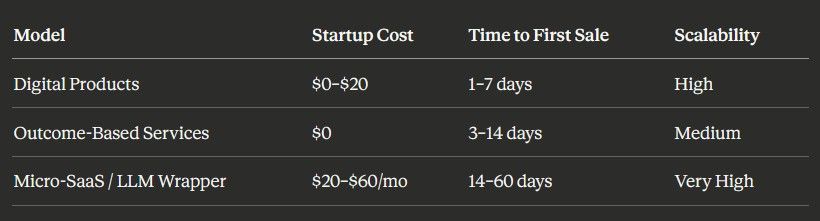 Each has a different risk profile. Let's break them down.
Model 1: The Digital Product "Annoyance Gap" Strategy
This is the fastest path to a first sale, especially if you have no audience.
Here's the core idea: find a specific frustration people complain about repeatedly, then solve it in a clean, downloadable format. A Notion template. A pricing calculator. A compliance checklist. A resume that beats ATS scanners. Something small, specific, and immediately useful.
The key concept here is the annoyance gap the space between a problem people complain about constantly and a tool that actually fixes it. Mine Reddit. Read one-star Amazon reviews. Spend time in niche forums. The people complaining loudly are telling you exactly what to build.
Pricing sits best in the $9–$19 range for beginners. That's the impulse-buy zone cheap enough that people don't need to think hard about it, but high enough that you only need 56 to 112 sales to hit $1,000.
Once the product is built, distribution is the job. And here's a method that community founders have used to great effect: the Value-First Post. Write an exhaustive guide on Reddit or a relevant forum that solves the problem for free like, genuinely solves it. Give away 90% of the value. At the very end, mention you built a template that automates the whole process. Link it softly.
One founder documented making $270 in 24 hours from cold Reddit traffic on a $13 product using exactly this method. That's a 1.2% conversion rate with zero ad spend. At $19 per product, you need 53 buyers. That's doable from borrowed community momentum.
Model 2: Outcome-Based B2B Services (The Fastest Cash)
This is the fastest route to $1,000 if you want to skip product creation entirely.
The traditional freelance model is collapsing. When AI can write copy, generate code, and analyze data in seconds, clients stop valuing your hours. They start valuing your outcomes.
The shift is simple but powerful: stop selling time, start selling results.
The highest-performing version of this in 2026 is the AI Tools Audit. Small business owners know they need to adopt AI to stay competitive. Most have no idea where to start. You interview them for 20 minutes, identify their top three time-wasting bottlenecks (missed inbound calls, manual appointment reminders, clunky data entry), then build a short report recommending three specific, no-code tools that fix each one.
Charge $200–$500 for the audit. Offer an implementation retainer for $1,000–$1,500 to set the tools up for them. Two clients gets you to $1,000 easily.
The acquisition method that works here: Proof of Work outreach. Don't pitch. Instead, find a prospect on LinkedIn, identify an obvious operational gap in how they run their business, record a two-minute Loom video walking through exactly what you'd fix, and send it to them. No call request. No sales language. Just: "Here's something I noticed. Feel free to use this."
That approach converts because it removes all risk from the buyer. They can see what they're getting before they spend a dollar.
Model 3: Micro-SaaS and the LLM Wrapper
This one takes more time upfront but has the highest ceiling.
AI has made it genuinely possible for non-developers to build functional software tools. The "vibe coding" wave using tools like Claude or ChatGPT to write entire apps from plain-English prompts has lowered the barrier to SaaS from years of learning to days of iteration.
A micro-SaaS is a tiny, focused app that solves one specific workflow problem for a specific audience. A browser extension that auto-generates personalized Upwork cover letters. A tool that turns dental clinic voicemails into text and routes them to the right staff member. Something small enough to build in a week, specific enough that competitors haven't bothered.
At $15–$30 per month per user, you need 34 to 67 paying customers to hit $1,000 in monthly recurring revenue. That's 34 people who found your tool valuable enough to keep paying a much smaller number than it sounds.
One caveat: every time a user interacts with your tool, you pay API costs. Build pricing that accounts for usage, or heavy users will eat your margins quickly.
The real play here isn't to aim for $1,000 in week one. It's to validate that people will pay for the solution before you build anything complicated. Pre-sell it. Charge three or five people for early access. If they pay, build it properly. If nobody bites after genuine outreach, the idea needs rethinking and you just saved yourself months.
The 30-Day Execution Sprint (Starting From Zero)
Theory doesn't put money in your account. Here's the week-by-week breakdown.
Week 1: Pick Your Model and Define Your Offer
Don't spend this week reading more articles. Spend it making a decision.
Audit your existing skills honestly. Not what you wish you were good at what you can actually do right now that saves someone time or money. Use an AI assistant to pressure-test your skill list and generate three specific, outcome-based offers you could pitch this week.
Pick one niche. Not "small businesses" too broad. Something like "automated follow-up for HVAC companies" or "Notion dashboards for solo accountants." Specificity is the difference between crickets and customers.
Week 2: Build the Minimum Version
Build the smallest version of your offer that delivers the core result. If it's a digital product, create a clean, focused MVP. If it's a service, record a Loom video demonstrating your process on a fake or volunteer client. If it's a SaaS idea, build a waitlist page and start manual outreach.
Don't polish. Don't add features. Don't redesign your logo. Ship something that works and get it in front of real people.
Week 3: Go Where Your Buyers Already Are
Find one or two communities where your exact buyer hangs out. LinkedIn works well for B2B services. Reddit and Indie Hackers work well for digital products and SaaS tools.
Post value first. Answer questions. Share insights. Build trust inside the community before you mention anything you're selling. When you do post your own content, use the Value-First method give away the answer, mention the tool.
Week 4: Read the Data, Adjust, Keep Going
If traffic is coming in but nobody's buying, the problem is pricing or copy. If nobody's even clicking, the problem is distribution or the hook. Don't abandon the model adjust the variables.
The single biggest mistake at this stage is pivoting too early. Most first-time founders quit right before the compound effect kicks in. Stay in the game. Iterate on what's not working. The first $1,000 rarely arrives in a clean straight line but it almost always arrives for people who don't stop.
The Hidden Obstacle: Getting Paid If You're Outside the US
Making the sale is only half the problem. Getting the money into your account is the other half and for founders in emerging markets, this is where a lot of revenue disappears into fees.
Traditional platforms like Wise have significantly restricted functionality in countries like Bangladesh and Pakistan as of 2026. If you're in a restricted region, here's the current landscape:
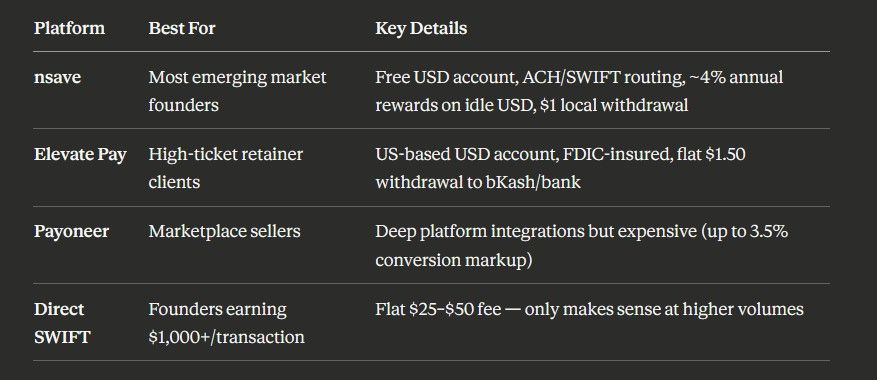 The cleanest move for a new founder: route client payments through nsave or Elevate Pay from day one, before you're dealing with large sums. The fee structures that seem minor at $100 become very meaningful at $1,000.
What the Indie Hacker Community Is Actually Saying
Spend time in the real communities Indie Hackers, r/Entrepreneur, Hacker News and a few consistent truths emerge.
Validation beats building. The most repeated advice: don't spend months making something, then launch to silence. Sell it first. If ten people won't pay you for the manual version, they won't pay for the automated one either.
The focus problem is real. Most beginners don't fail because they picked the wrong model. They fail because they picked three models simultaneously, got overwhelmed, and quit. Pick one thing. Give it 60 days. Then evaluate.
Authenticity converts. The brands and creators cutting through the noise right now aren't the most polished ones. They're the most real ones. A raw Loom video of you walking through a client's problem will out-convert a slick sales page almost every time. The "Human Premium" is real and it's growing.
As one founder put it on Indie Hackers: "You'll know if you're onto something real. If people buy it, you just validated a business idea. If they don't, you just saved yourself six months."
Final Thought: The Engine Is Slow, but It Runs
The first $1,000 online is not a hack. It's not a cheat code. It's not found in a $497 course.
It's the result of picking a model that fits the current market, building the minimum version of it, getting it in front of real people, and not stopping when the first post gets no replies.
Every founder on MRR Story started exactly where you are. Some of them made their first $47 selling a Notion template. Some built a $1.6K MRR SaaS after quitting their job. The amounts were different. The timeline was different. The model was different.
What wasn't different: they picked something real, they shipped it, and they stayed in the game long enough to find out.
That's the blueprint.