How to Build a SaaS Without Coding in 2026 (Definitive Guide)
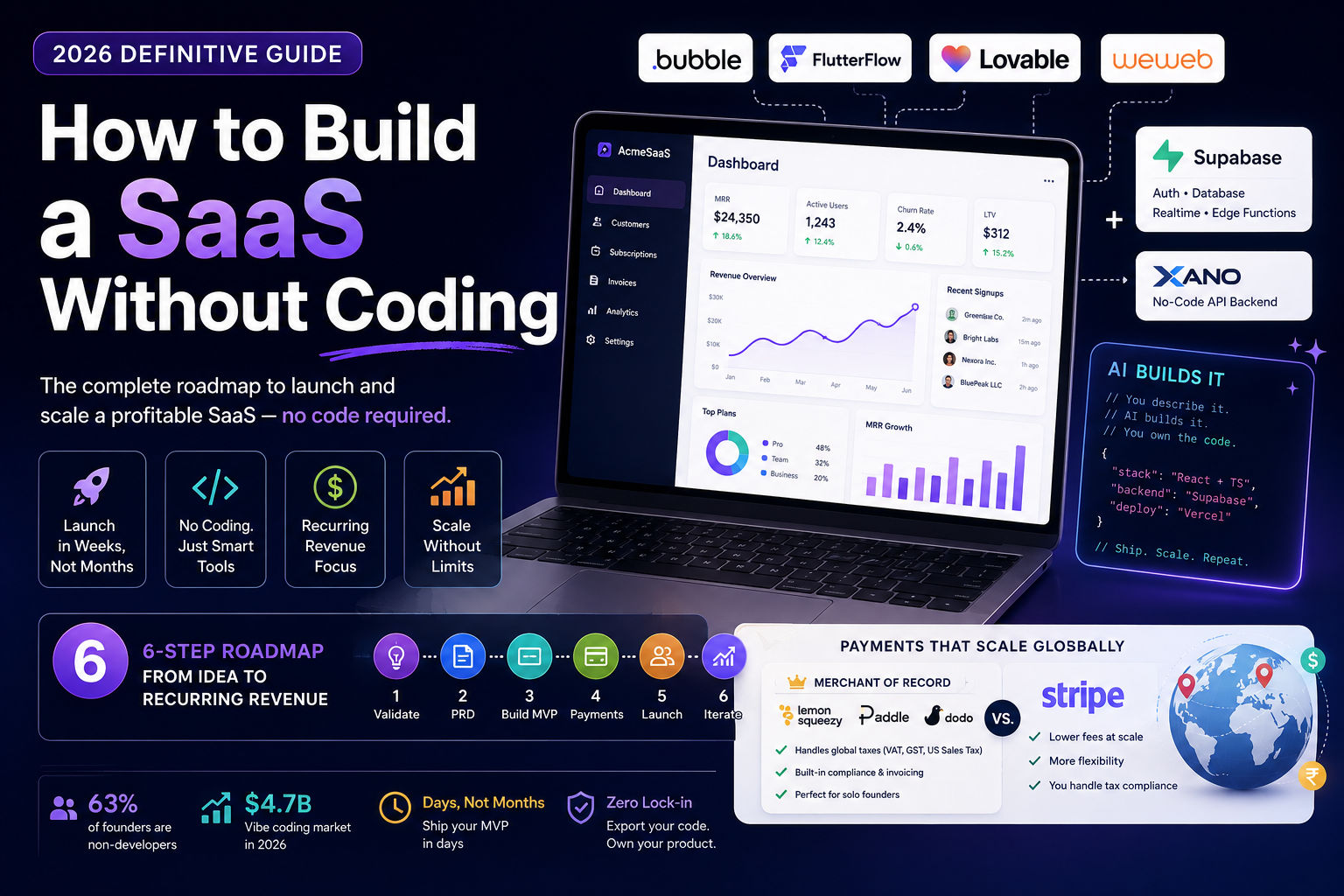
You can build a real SaaS in 2026 without writing a single line of code using tools like Bubble, Lovable, or FlutterFlow. But the tech is the easy part. This guide covers the exact steps, real costs, and hidden traps that separate founders who launch from those who just keep building.
Here's something that would have sounded insane five years ago: a solo founder with zero coding experience, working from a laptop, built a subscription software product and scaled it to $240,000 in annual revenue before being acquired in a seven-figure deal.
That's not a tweet from a crypto bro. That's Flusk a real Bubble-built cybersecurity tool that was eventually bought by Bubble itself.
This is what the no-code SaaS world looks like in 2026. And while the tools are genuinely extraordinary, the path from "I have an idea" to "I have paying customers" is nowhere near as smooth as the marketing makes it look.
This guide exists to show you the real picture the tools that work, the traps that quietly kill projects, and the exact steps successful indie founders follow to go from zero to recurring revenue without writing a single line of code.
Can You Actually Build a SaaS Without Coding?
Short answer: Yes. Completely.
In 2026, non-technical founders use two main approaches to build fully functional, revenue-generating SaaS products:
- Visual development platforms like Bubble and FlutterFlow drag-and-drop environments where you configure databases, logic, and interfaces without touching syntax
- AI-native builders like Lovable and Bolt.new tools where you describe what you want in plain English and the AI generates a working React codebase behind the scenes
These aren't toys. They're powering multi-tenant B2B platforms, consumer mobile apps, and enterprise internal tools right now. The vibe coding market alone is estimated at $4.7 billion in 2026, and 63% of founders using these tools identify as non-developers.
The barrier to building software has collapsed. The barrier to building a business has not. That distinction matters more than anything else in this guide.
The Two Paths: Visual Builders vs. Vibe Coding
Before you pick a tool, you need to understand how these two paradigms actually work because they create very different products with very different trade-offs.
Visual Full-Stack Environments
These platforms give you a graphical editor where you wire up database tables, design screens, and configure logic flows. The entire app runs on the platform's infrastructure, which is both the strength and the weakness.
The upside: guardrails. Visual builders make it much harder to create fundamentally broken architecture. They're predictable. If something works in testing, it tends to work in production.
The downside: lock-in. If you build on Bubble and decide to leave Bubble, you're starting from scratch. Your app doesn't export into a codebase you can take elsewhere.
AI-Native Builders and "Vibe Coding"
Andrej Karpathy coined the term "vibe coding" in early 2025, and it describes something genuinely new: describing what you want in plain English while an AI writes the actual React, TypeScript, and database logic in the background.
Platforms like Lovable take your prompt and output a working application connected to a Supabase backend, pushed to a GitHub repo all without you touching a terminal. The code is yours. You can export it, hire a developer to extend it, or migrate it freely.
The upside: portability and speed. A functional MVP in days, not months.
The downside: the AI doesn't understand your long-term architecture. It solves each problem locally. Stack enough of those local solutions together without a plan, and you end up with what the developer community calls "spaghetti code" something that technically runs but nobody can maintain or scale.
Choosing the Right Platform for Your SaaS
Here's where most beginner guides let you down. They list tools without telling you when each one actually makes sense.
Platform Best For Code Export Lock-in Risk Starting Price Bubble Complex web SaaS, ERPs, marketplaces No High $32/mo FlutterFlow Native iOS/Android apps Yes (Flutter/Dart) Zero $30/mo Lovable Rapid MVPs, React web apps Yes (React) Zero $20/mo WeWeb Enterprise web frontends Yes (Vue/React) Low €20/mo Cursor AI-augmented code editing Yes Zero $20/mo
Use Bubble if: You're building a complex B2B web app with intricate multi-step logic a marketplace, a workflow automation tool, an ERP. Accept the lock-in as the price of powerful visual orchestration. Budget 3–5 months to get genuinely proficient.
Use FlutterFlow if: Your SaaS lives on mobile. You need native GPS, camera access, push notifications, or offline caching. The Flutter/Dart code exports cleanly, giving you a real exit ramp if the product outgrows the platform. You'll need to pair it with an external backend like Supabase or Xano.
Use Lovable if: You need to move fast on a web-based MVP. It's the closest thing to magic that actually works describe your product, get a React app connected to Supabase, deploy in minutes. Zero vendor lock-in.
What About the Backend?
Most visual frontend tools need a separate backend to store user data and run server-side logic. Two options dominate in 2026:
Supabase is the open-source PostgreSQL database platform most indie founders reach for first. It handles authentication, real-time subscriptions, and edge functions. It's free to start, scales cleanly, and doesn't trap your data.
Xano is the choice when you need a sophisticated no-code API layer especially if your frontend and backend are completely separate tools. It's stack-agnostic, meaning it can power a Webflow site and a FlutterFlow mobile app simultaneously from the same backend.
The Vibe Coding Trap Nobody Warns You About
There's a specific failure pattern that shows up constantly in indie founder communities, and understanding it might save your entire project.
A founder gets excited about AI-native builders. They spend a weekend prompting Lovable or Bolt.new, watching their app take shape. In days, they have something that looks production-ready. They launch, get their first users, and then somewhere around user 50 everything starts breaking. Slow queries. Concurrency errors. A database schema that made sense for 10 users but collapses under 500.
This happens because AI agents are optimized to solve the problem you just described. They're not thinking six months ahead. Each prompt adds a new layer of logic on top of whatever was already there. After enough iterations, the architecture is genuinely fragile a description community members on Indie Hackers use that cuts deep: "giant plates of spaghetti that nobody can maintain."
How to Avoid It
Step 1: Demand the blueprint before any building starts. Before your first feature prompt, explicitly ask the AI to map out the file structure, define the database schema, and document the API architecture. Treat the AI like a senior architect, not a fast typist.
Step 2: Build one thing at a time. Describe one core user action. Test it thoroughly. Then add complexity. Never prompt the AI to build the entire product at once.
Step 3: Stick to boring, well-documented stacks. AI agents hallucinate far less when working with React, Tailwind, and Supabase frameworks with millions of training examples. The more exotic your stack, the more improvisation (and fragility) you get.
The 6-Step Roadmap to Launching Your No-Code SaaS
This is the sequence that separates the founders who ship and earn from the ones who build forever and launch never.
Step 1: Validate Before You Build Anything
The most expensive mistake in indie hacking isn't a bad tool choice. It's spending two months building something nobody wants.
The ideas that consistently work in 2026 are what the community calls "boring SaaS" highly specific B2B tools for unglamorous problems. Compliance renewal trackers. Subscription payment recovery tools for niche verticals. Certification expiry reminders for small businesses.
Before touching any platform, your idea needs to pass five questions:
- Is this an urgent problem, not a nice-to-have?
- Is the target audience specific enough to find and reach?
- Does it justify a monthly subscription?
- Can you beat the slow legacy competition?
- Do you have real access to a distribution channel?
The Reddit validation approach works better than a landing page: find niche subreddits or forums where your target audience actually complains. When you see the same specific frustration repeated by real people who aren't your friends, you have signal. When you can sell the outcome manually via a spreadsheet, a Notion template, your own hands before building a single screen, you have confirmation.
Step 2: Write a Product Requirements Document (PRD)
This document is your architectural bible. It protects you from scope creep, and it gives AI agents the context they need to generate coherent, stable code.
A useful PRD for a no-code SaaS includes:
- The primary user persona (one specific person, not "small businesses")
- The one core action the software performs
- The database tables needed (e.g., Users, Organizations, Subscriptions)
- Third-party integrations required (Stripe for payments, SendGrid for email)
- What the MVP explicitly does NOT include
That last point matters. Cut your planned feature list by 50%. Then cut it again. Ship the smallest version that delivers the core value.
Step 3: Build the MVP
Now you build using the PRD as your prompt template if you're using an AI-native builder, or as a reference document if you're working in Bubble or FlutterFlow.
The goal is not a beautiful product. The goal is something that actually performs the core function, handles authentication, and doesn't break when two people use it at the same time. Lovable connected to Supabase is the fastest path for most web-based MVPs. FlutterFlow connected to Supabase or Firebase is the fastest path for mobile.
Step 4: Integrate Payments and Security Before Launch
An app without billing is a hobby. And a hobby that handles user data insecurely is a liability.
For payments, you have two directions depending on your situation:
Stripe is flexible and has lower processing fees at scale. If you're based in a country with full Stripe support and aren't worried about international tax filing, it's technically excellent.
Merchant of Record platforms (Lemon Squeezy, Paddle, Dodo Payments) are a different model entirely and for many solo founders, they're the smarter choice. An MoR acts as the legal seller of your product. When a customer buys, they're buying from the MoR, not from you directly. The MoR handles VAT collection for European customers, digital service taxes in Asia, fragmented US state sales tax, and remits all of it automatically. For a solo founder managing everything alone, offloading global tax compliance is worth every basis point of the fee difference.
This is especially critical for founders operating outside Western markets. Bangladesh, for instance, has over 750,000 IT professionals and a fast-growing indie software scene but standard Stripe merchant accounts and PayPal business accounts remain unsupported for local founders. An MoR platform with global payment rails solves this entirely, allowing borderless revenue collection without a foreign entity or overseas bank account.
Step 5: Launch Small and Watch the Data
Don't announce to the world on launch day. Send access to 20–30 specific people from the communities you've been part of.
The metric that matters most early on is Time-to-Value: how long does it take a new user to experience the thing your product actually does? If they sign up and wander around confused for 10 minutes, you have an onboarding problem. If they hit the core feature in 60 seconds, you're in a position to grow.
High early churn is information, not failure. It usually means the onboarding is broken, not the idea.
Step 6: Iterate at No-Code Speed
This is the actual competitive advantage of building without code. When a user asks for a feature change or reports a friction point, you can ship the update in hours — not weeks. No engineering backlog. No sprint planning. Just prompt, test, deploy.
That responsiveness, compounded over months, becomes a genuine moat against slow-moving enterprise competitors.
Distribution: The Part That Actually Determines Success
Community data is brutal on this point. Roughly 99% of solo founders cite distribution as their primary failure point. Not the product. Not the tech stack. Distribution.
Building is now the easy part. Reaching people who will pay is the hard part.
What Actually Works for Zero-Budget Founders
Building in public on X or LinkedIn means documenting the real process the ugly early metrics, the pivot decisions, the first customer story. In 2026, people buy from people, not from products. Authentic founder narratives build trust faster than any ad campaign.
Community-led growth means showing up in niche subreddits, Discord servers, and Indie Hackers threads with genuine value before ever mentioning your product. The rule of thumb from experienced founders: contribute ten times before you mention what you're building once. When you do mention it, the community already knows and trusts you.
Programmatic SEO means creating pages that capture specific, high-intent searches at scale often using your own SaaS data. If you build a compliance tracker for dental practices, you should have a page for every state's specific compliance requirements. These pages capture search traffic passively while you focus on building.
The Anti-Patterns That Drain Energy and Kill Projects
Building for everyone instead of someone specific. Copying the feature set of a funded competitor. Spending your mornings tweaking button colors instead of doing cold outreach. These patterns are predictable and lethal.
What Happens When Your SaaS Actually Takes Off
Most no-code guides stop at "launch your MVP." This one won't, because what happens after launch is where most projects silently die.
The Scaling Problem
Bubble's pricing is based on "Workload Units" essentially a measure of database and workflow computation. As your user base grows and queries become more complex, those WUs stack up fast. Poorly optimized database queries in Bubble genuinely choke at high data volumes, creating slow page loads and frustrated users who quietly churn.
Make.com has a similar issue on the automation side: it's excellent for lightweight marketing workflows, but high-frequency API webhook executions can mathematically bankrupt a scaling micro SaaS in months.
The answer isn't to panic and rewrite everything. The answer is to decouple aggressively. Keep your core data on an exportable platform like Supabase or Xano from day one. Use your visual builder or AI generator strictly for rendering. When automation costs spike, migrate specific high-volume workflows to self-hosted n8n rather than rebuilding your entire product.
Pricing in the AI Era
If your SaaS uses AI features, seat-based pricing is dying. When users trigger AI workflows generating content, analyzing data, processing documents those calls cost you real money in API fees to OpenAI or Anthropic. A flat monthly fee doesn't account for the power user who processes 10,000 records while the typical user processes 100.
The model most successful in 2026 is hybrid: a base subscription that covers core features, with variable charges specifically tied to AI usage. Show users their consumption in real time. Nobody should be surprised by an invoice.
What Your SaaS Is Worth (and What Kills Its Value)
If you ever want to sell, the market in 2026 pays 3x to 8x ARR for private, profitable SaaS companies. That's the range but where you land within it depends heavily on two things.
First: defensibility. SaaS products that deeply embed into daily workflows compliance tracking, B2B data sync, hardware integration are hard to rip out. Buyers pay premiums for products with "pain with a calendar" dynamics, where not using the software results in direct financial consequences for the customer.
Second: architecture cleanliness. Startups built on fragile, AI-hallucinated spaghetti code are increasingly failing technical due diligence. Acquirers want codebases they can absorb and maintain. A clean Lovable export or a well-organized Bubble environment closes faster and at better multiples than a brittle prototype nobody can audit.
Frequently Asked Questions
How long does it actually take to build a no-code SaaS? A functional MVP can be generated in 3 to 14 days using AI-native builders. Production-ready software with secure authentication, error handling, and payment flows realistically takes 4 to 6 weeks of careful configuration and testing.
How much does it cost to launch a no-code SaaS? Prototyping can happen for under $100/month. A standard early production stack (AI builder + Supabase + automation tool) runs $45–$117/month. As users scale, costs can rise into the hundreds or thousands depending on usage-based billing tiers.
What's the difference between Stripe and a Merchant of Record? Stripe processes payments and handles the technical infrastructure. You remain legally responsible for calculating and remitting sales taxes globally. A Merchant of Record like Lemon Squeezy, Paddle, or Dodo Payments acts as the legal seller they collect and remit all global taxes automatically on your behalf.
Is vibe coding really safe for a production app? It can be, if you establish the architectural blueprint before generating any features. The risk comes from prompting blindly without a clear data schema and file structure defined first. AI-generated apps on well-documented stacks like React + Supabase tend to be significantly more stable.
What's the fastest path to $1,000 MRR? Industry data suggests two to six months is realistic when the idea has been validated against real community pain points first. Products targeting specific, painful B2B workflows not broad consumer apps reach $1,000 MRR significantly faster.
The Final Honest Take
Here's what nobody in the "build a SaaS in a weekend" genre will tell you: the hard part was never the code.
The hard part is finding a real problem worth solving, validating that people will actually pay for the solution, building distribution before you build features, and staying disciplined when the tools make it tempting to overbuild.
The best no-code founders in 2026 treat the technology as a commodity. They obsess over the problem, the customer, and the distribution channel. They pick boring, defensible niches. They use Supabase and Lovable and FlutterFlow as utilities, not as competitive advantages.
The barrier to entry is lower than it has ever been. That means the signal the quality of the idea, the sharpness of the distribution, the depth of the customer relationship matters more than it ever has.
Start with a real problem. Validate it ruthlessly. Build the smallest possible version that solves it. Then put everything you have into getting it in front of the right people.
The tools will handle the rest.
SEO Optimization Summary
Primary keyword used: how to build a SaaS without coding
Secondary keywords used: no-code SaaS, vibe coding, AI-native app builder, micro SaaS, best no-code tools for SaaS, SaaS payment gateway, merchant of record, usage-based pricing, visual full-stack environments, no-code scaling
Semantic entities covered: Bubble, FlutterFlow, Lovable, Supabase, Xano, Firebase, Stripe, Lemon Squeezy, Paddle, Dodo Payments, Make.com, n8n, Zapier, Cursor, React, TypeScript, Flutter/Dart, PostgreSQL, MRR, ARR, churn, CAC, LTV, MVP, PRD, RBAC, webhooks, vibe coding, indie hacking, bootstrapping, solopreneur, vendor lock-in, technical debt, Workload Units (WU), Net Dollar Retention (NDR), EV/Revenue multiples
Suggested internal link opportunities:
- "Merchant of Record" → internal deep-dive on global SaaS compliance and tax
- "vibe coding" → technical tutorial on structuring AI agent prompts
- "Supabase" → guide on setting up authentication and RBAC without code
- "programmatic SEO" → playbook for SaaS SEO architecture
- "no-code scaling" → article on Bubble Workload Unit optimization
Suggested image ideas:
- Architecture diagram: coupled visual builder (Bubble) vs. decoupled frontend + BaaS stack (Lovable + Supabase)
- Screenshot: example PRD used as an AI generation context prompt
- Comparison chart: Bubble WU cost trajectory vs. Supabase usage-based scaling
Suggested infographic ideas:
- Decision flowchart: Visual Builder (Bubble) vs. AI-Native Builder (Lovable) vs. Mobile Compiler (FlutterFlow) based on use case, mobile need, and export requirement
- 6-step no-code SaaS roadmap: linear visual from Validation → PRD → MVP → Payments → Launch → Iteration
- MoR vs. Stripe comparison: who handles what, for which type of founder