How to Build an AI Tool as a Solo Founder in 2026
SEO Metadata
SEO Title: How to Build an AI Tool as a Solo Founder in 2026: The Definitive Guide
Meta Description: Discover the exact AI tech stack, context engineering frameworks, Model Context Protocol (MCP) integrations, and GEO strategies solo founders use to build and scale unicorn startups in 2026.
How to Build an AI Tool as a Solo Founder in 2026: The Definitive Guide
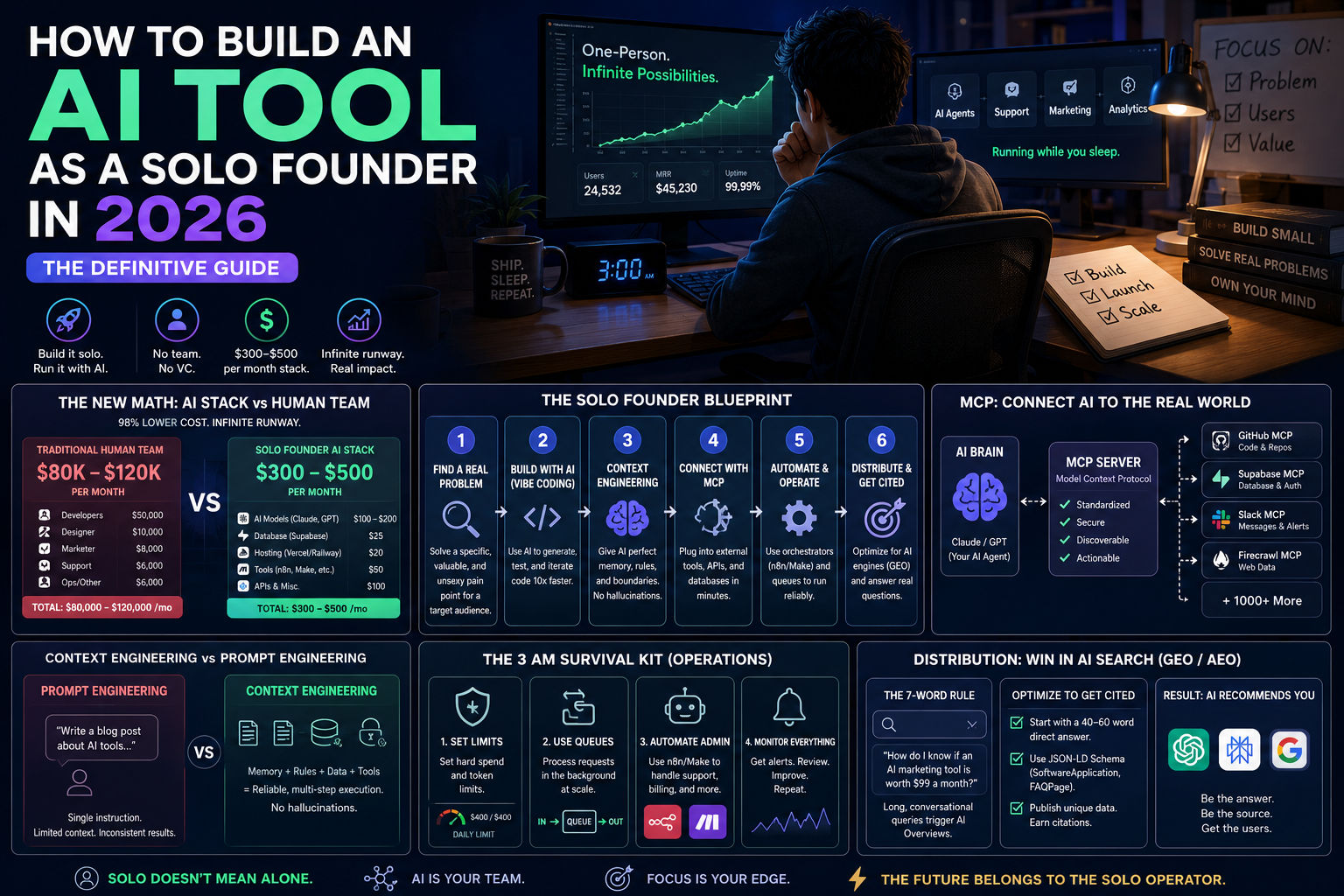
Picture this: It is 3:00 AM. You are sitting at your desk, staring at a screen. You haven't hired a single employee. You haven't taken a dime of venture capital. Yet, you are running a software company that processes thousands of daily users, handles its own customer support, writes its own marketing copy, and ships new features while you sleep.
Three years ago, this was science fiction. Today, it is the reality of the "one-person unicorn."
The traditional way of building a startup is dead. You no longer need to raise millions of dollars to hire a 10-person team of developers, designers, and marketers. In fact, in early 2026, data showed that 36.3% of all new startups were launched by solo founders.
Why? Because the barrier to writing code has completely vanished.
But here is the hard truth that Reddit forums and IndieHackers communities are screaming about right now: Building an AI tool is incredibly easy. Getting people to actually pay for it is harder than ever.
If you want to know how to build an AI tool as a solo founder, you don't just need a coding tutorial. You need a survival guide. You need to know how to build a tech stack that won't break, how to avoid the deadly "AI wrapper" trap, and how to get your tool discovered by AI search engines like ChatGPT and Perplexity.
Let’s break down the exact blueprint to build, launch, and scale a solo AI startup in 2026.
The New Math: Why Solo Founders Are Winning
To understand why solo founders are dominating right now, we have to look at the math. The financial difference between a human team and an AI stack is staggering.
Historically, a functional startup team (coding, marketing, support, and design) cost between $80,000 and $120,000 every single month in payroll.
In 2026, a solo founder AI tech stack costs between $300 and $500 per month.
Here is what that looks like:
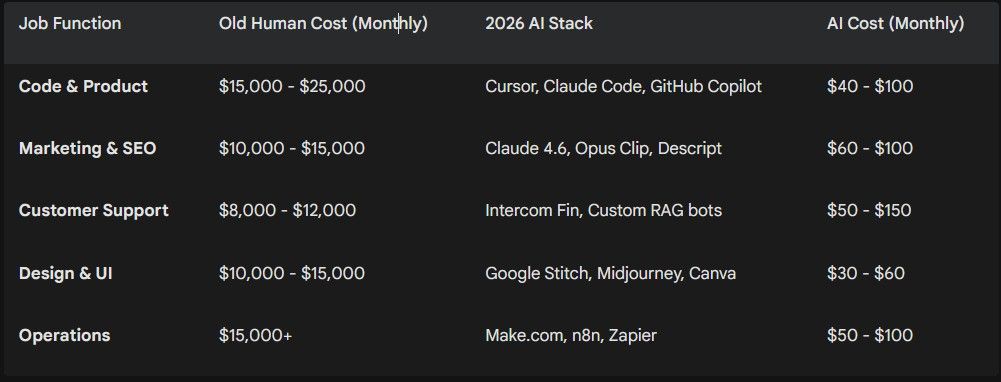 This 98% reduction in cost gives you the ultimate superpower: infinite runway. You don't have to panic if you don't make $10,000 in your first month. You have the time to find real customers and fix real problems.
Step 1: Escape the "AI Wrapper" Trap
Before you write a single line of code, we need to talk about the graveyard of dead AI startups.
If you browse communities like r/SaaS, you will hear the term "AI wrapper." An AI wrapper is a simple app that takes a user's text, sends it to ChatGPT's API, and spits the answer back into a slightly prettier interface.
Do not build an AI wrapper.
In 2026, simple wrappers are dead. Big companies like Apple, Google, and Notion have already built these simple features (like grammar checking, summarizing, and translation) directly into their free products. Users will not pay you $10 a month for something their phone does for free.
What to Build Instead: The Unsexy B2B Tool
The most successful one-person AI business models today solve highly specific, "unsexy" problems for businesses.
Instead of building a generic "AI blog writer," build an AI tool that reads messy inventory spreadsheets for local plumbers and automatically formats them into quick order forms. Businesses will gladly pay $99 a month if your tool saves them three hours of boring work every Friday.
Look for pain points, not cool tricks.
Step 2: The 2026 Solo Founder AI Tech Stack
So, how do you actually build the app? You have two paths: No-Code or the Pro Stack.
The No-Code AI Builder Path
If you have zero coding experience, this is your route. The best no code AI builders for startups in 2026 allow you to explain what you want in plain English, and the platform builds the app for you.
-
Lovable & Bolt.new: Incredible for rapidly generating full web applications just by typing prompts.
-
Bubble & FlutterFlow: Better for complex logic and connecting to external databases.
The Pro Developer Path (Vibe Coding)
If you want to own your code and avoid high platform fees, you will use the modern developer stack.
But you won't be typing out code character by character. You will be "vibe coding."
Vibe coding is a modern development method where you describe your software needs in natural language to an AI coding assistant (like Cursor or Claude Code), and the AI writes, tests, and fixes the actual code. You act as the manager; the AI acts as the typist.
A standard pro stack looks like this:
-
Frontend: Next.js (Fast, great for SEO).
-
Backend: FastAPI with Python (Perfect for heavy AI tasks).
-
Database: Supabase (PostgreSQL) and Pinecone (Vector database for AI memory).
-
Brain: Claude Sonnet 4.6 (for coding) and GPT-5.5 (for logic workflows).
Step 3: Context Engineering (Your Secret Weapon)
This is the most important technical shift of the decade.
Context engineering is the process of architecting the information environment including memory stores, databases, and API tools to ensure AI agents execute reliably across multi-step workflows without making things up.
A year ago, everyone talked about "prompt engineering" (typing clever questions to ChatGPT). Today, prompt engineering is mostly useless for building actual software.
Context Engineering vs Prompt Engineering
Prompt engineering is about giving a single instruction. Context engineering is about giving the AI perfect memory and boundaries.
If your AI tool doesn't have the right context, it will hallucinate (make up fake answers). To solve this, solo founders use CLAUDE.md files. This is a master document you put in your project folder. It tells your AI assistant exactly what your business does, what database rules to follow, and what coding style to use.
Whenever the AI works, it reads the context file first. This stops the AI from breaking your app at 3 AM.
Step 4: Connecting the Dots with MCP
If you want your AI tool to actually do things like check a user's calendar, read a Google Doc, or send a Slack message you need to connect it to the outside world.
In the past, this took weeks of painful API coding. Now, we have MCP.
The Model Context Protocol (MCP) is an open standard that lets AI models securely connect to external tools, databases, and APIs without requiring custom middleware.
Think of MCP like a menu at a restaurant. Instead of the AI trying to guess how to cook a meal in your kitchen (your database), the MCP server hands the AI a clean menu of exact actions it is allowed to take.
-
GitHub MCP: Lets your AI read and push code.
-
Supabase MCP: Lets your AI securely search your user database.
-
Firecrawl MCP: Lets your AI read and understand any website on the internet.
By plugging in MCP servers, a solo founder can give their app massive capabilities in minutes instead of months.
Step 5: The 3 AM Debugging Nightmare (Operations)
Building the tool is fun. Running it in production is terrifying.
Community forums are filled with solo founders experiencing burnout from "AI automation." They set up 10 different AI agents to run their business, go to sleep, and wake up to find their agents got stuck in an infinite loop, draining $400 in API costs overnight.
To survive, you must act like a systems architect:
-
Set Hard Token Limits: Never give an AI an unlimited budget. Set strict daily spend limits on your OpenAI or Anthropic accounts.
-
Use Background Queues: If 100 users ask your AI a question at the same time, your app will crash. Use tools to put requests in a "queue" or waiting line.
-
Use Orchestrators for Admin: Don't write code for basic admin tasks. Use n8n or Zapier to automatically handle customer support emails or failed Stripe payments.
Step 6: Distribution and Generative Engine Optimization (GEO)
We have reached the final boss. You built the tool. It works perfectly. Now, you launch it to the world... and hear crickets.
The "build it and they will come" strategy is the number one reason solo founders fail. You cannot just rely on old-school Google SEO anymore. Traditional SEO is dying because users are getting their answers directly from AI Overviews, ChatGPT, and Perplexity.
To get users in 2026, you need Generative Engine Optimization (GEO) and Answer Engine Optimization (AEO).
The 7-Word Rule
AI search engines don't care about short keywords like "AI marketing tool." They care about long, conversational questions.
Data shows that search queries with 7 or more words trigger AI Overviews highly effectively. You need to optimize your website for questions like: "How do I know if an AI marketing tool is worth $99 a month?"
How to Optimize for AI Overviews
To make sure ChatGPT and Google's AI recommend your tool to users, follow these rules:
-
The Citation Block: AI models are lazy. They want answers fast. Start your blog posts or FAQ sections with a direct, 40-to-60-word answer. Use dictionary-style language (e.g., "X is defined as...").
-
Use JSON-LD Schema: This is invisible code you put on your website that spoon-feeds facts to AI bots. You must use
SoftwareApplicationschema (to tell the AI what your tool does and costs) andFAQPageschema. -
Information Gain: AI models will ignore your website if you just repeat what everyone else says. You need to publish unique data. Share your real revenue numbers, post a solo founder failure rate database, or create a free AI API cost calculator. Unique data gets cited.
Case Studies: Solo Founders Winning Big
This isn't just theory. Real people are doing this right now.
-
The UI Innovator: One founder realized ChatGPT's early interface was clunky. Instead of building a new AI, he built a beautiful "wrapper" interface over the existing API. Because his design was flawless, he hit $45K in Monthly Recurring Revenue (MRR) incredibly fast.
-
The Niche Automator: Another founder built an API that just generated images automatically for social media marketers. By using "Coding Weeks" and "Marketing Weeks" strictly, he scaled to over $600K in Annual Recurring Revenue (ARR) completely alone.
The secret? They didn't try to build a massive, complex Artificial General Intelligence (AGI). They solved a small, annoying problem perfectly.
The Future Belongs to the Solo Operator
The bottleneck is no longer human capital. It is human taste, strategy, and resilience.
If you want to build an AI tool as a solo founder, stop worrying about whether you are a "good enough" coder. Vibe coding has solved that. Start obsessing over context engineering to make your tool reliable. Start obsessing over Generative Engine Optimization (GEO) to ensure people can find you.
The tools are cheap. The agents are ready. The only question is: what are you going to build?
Frequently Asked Questions (FAQ)
What is the core tech stack for a solo AI founder in 2026?
The modern solo stack requires $300 to $500 per month and consists of Cursor or Claude Code for AI-assisted development, Claude 4.6 and GPT-5.5 for logic, Google Stitch for UI/UX design, Intercom Fin for support, and an orchestration layer like Make or n8n to connect all APIs.
How does Vibe Coding replace traditional software development?
Vibe coding collapses the distance between idea and execution. Instead of writing manual syntax, founders use natural language to describe features and logic to AI environments like Cursor. The AI generates, tests, and refactors the code, allowing founders to ship features in hours rather than weeks.
What is Context Engineering and why is it more important than Prompt Engineering?
Prompt engineering focuses on issuing single instructions to an AI. Context engineering is the architectural practice of designing the entire information environment using memory maintenance and CLAUDE.md files to ensure the AI agent has perfect situational awareness across complex workflows without hallucinating.
What is the Model Context Protocol (MCP) and how do I use it?
MCP is an open standard that allows AI assistants to connect directly to external tools and databases (like GitHub, Postgres, or Slack) via standardized servers, eliminating the need for custom API middleware.
How do I market an AI SaaS alone?
Traditional SEO is highly competitive. To market alone, focus on Answer Engine Optimization (AEO) and Generative Engine Optimization (GEO). Target 7-word conversational queries, structure your site with JSON-LD schema, and build free micro-tools to naturally attract links and citations from AI search engines.
SEO Optimization Summary
-
Primary Keyword Used: how to build an AI tool as a solo founder
-
Secondary Keywords Used: solo founder AI tech stack 2026, best no code AI builder for startups, context engineering vs prompt engineering, vibe coding tutorial for non technical founders, how to market an AI SaaS alone, AI Overview optimization for SaaS B2B, Generative Engine Optimization (GEO).
-
Semantic Entities Covered: Context Engineering, Model Context Protocol (MCP), Vibe Coding, n8n, Supabase, Cursor, JSON-LD Schema, AI Wrappers.
-
Suggested Internal Links:
-
Link "Model Context Protocol (MCP)" to your technical setup guides.
-
Link "Generative Engine Optimization (GEO)" to your deep-dive SEO marketing content.
-
Link "Vibe Coding" to your specific Cursor/Claude setup tutorials.
-
-
Suggested Image Ideas:
-
A clean comparison table graphic showing the $100k human team vs. the $400 AI stack.
-
A diagram showing how an MCP server connects an AI brain to a database.
-
-
Suggested Infographic Idea: The "3-Layer Entity Authority Framework" showing how raw data turns into structured schema, which turns into AI citations.