15 Profitable Micro SaaS Ideas for Solo Founders in 2026
 The software landscape has shifted dramatically. In early 2026, we saw a massive market correction over $2 trillion in software sector market cap evaporated. Legacy platforms and superficial "AI wrappers" took devastating hits. But within this chaos, a highly lucrative opportunity emerged for the indie maker: the one-person SaaS business.
If you are looking for profitable micro SaaS ideas for solo founders in 2026, the playbook has changed. Enterprise giants are dominating broad, horizontal infrastructure. The real wealth for solo operators lies in building highly specific, vertical solutions for underserved niches. In fact, while generic AI tools struggle, niche SaaS products in sectors like B2B sales and content creation are averaging massive monthly recurring revenue (MRR) margins of 70% to 80%.
This guide breaks down 15 validated micro SaaS ideas in 2026, complete with revenue models, build metrics, and the exact validation frameworks you need to launch successfully.
Table of Contents
What is a Micro SaaS? (And Why Start One in 2026?)
What is a micro SaaS? A micro SaaS is a highly specialized, subscription-based software business operated by a solo founder or a micro-team. It targets a narrow niche market, solves a point-of-interest problem with high precision, operates with low overhead costs, and relies on a recurring revenue model to achieve high profitability.
The global public cloud market is projected to reach $811.8 billion, but you don't need a massive slice of that pie to build life-changing wealth. A successful bootstrapped startup only needs 100 to 500 loyal customers paying $50 to $100 a month to generate a comfortable, profitable living.
Micro SaaS vs. Standard SaaS
 Here is how the micro SaaS model stacks up against standard venture-backed SaaS:
-
Target Audience: Standard SaaS targets broad, horizontal global markets. Micro SaaS focuses on hyper-specific vertical niches.
-
Team Size: Standard SaaS requires 100+ employees. Micro SaaS is operated by 1–3 founders (indie makers).
-
Funding: Standard SaaS relies on high-pressure Venture Capital. Micro SaaS is entirely bootstrapped, offering high freedom.
-
Customer Acquisition: Standard SaaS needs massive enterprise sales teams. Micro SaaS relies on organic SEO, niche communities, and MRRStory guides.
-
Profit Margins: Standard SaaS often operates with negative margins in early growth stages. Micro SaaS can achieve 70% - 80% margins from day one.
TL;DR: The best micro SaaS businesses to start in 2026 avoid fighting giants. They act as "painkillers" rather than "vitamins" for specific, narrow audiences.
Category 1: Autonomous Agentic Workflows
Conversational chat interfaces are outdated. Today's businesses want software that executes work autonomously. These AI micro SaaS ideas focus on agentic workflows that save B2B clients measurable labor hours.
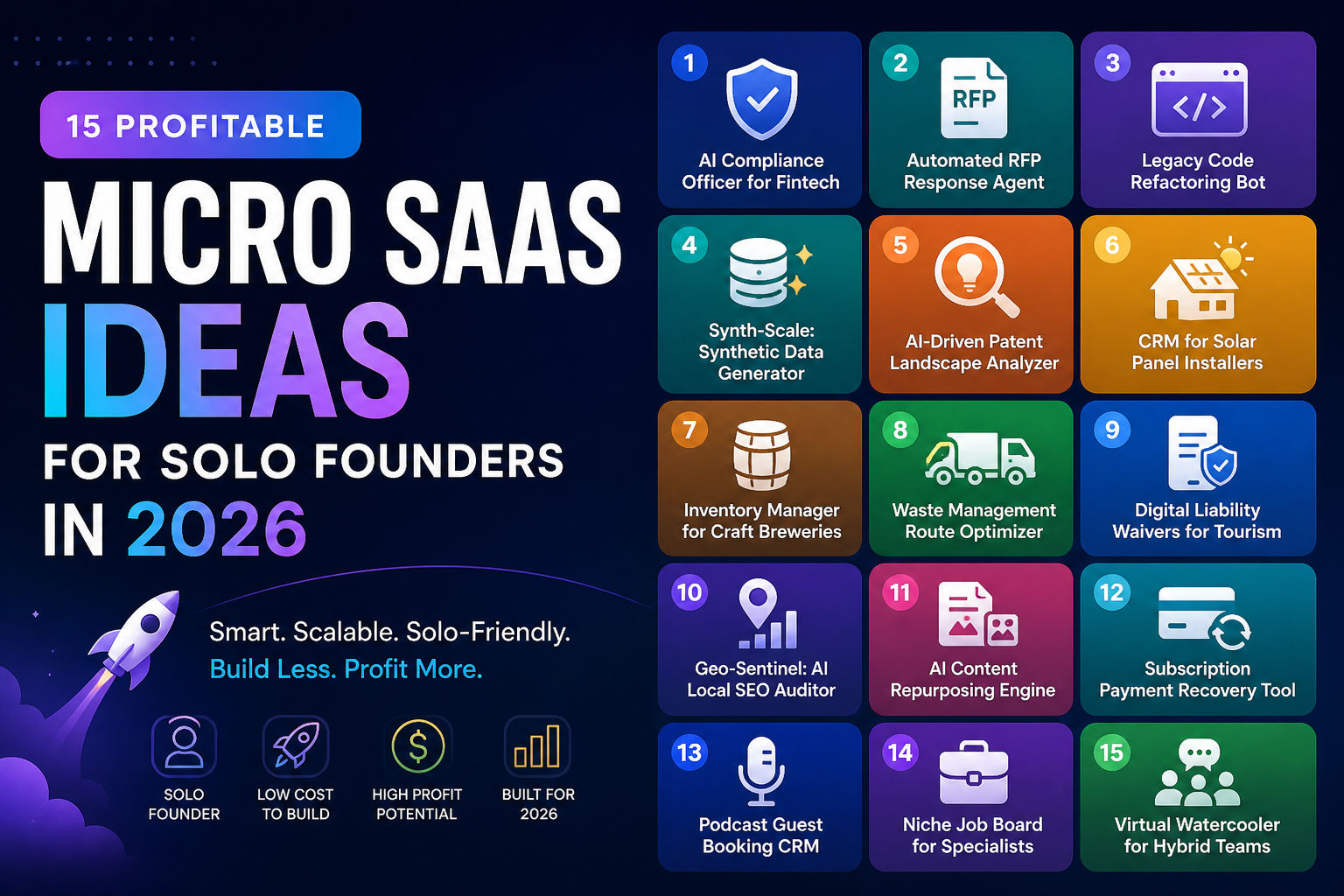
1. AI Compliance Officer for Fintech
Early-stage fintech CTOs cannot afford massive legal teams to manage tightening regional banking regulations (GDPR, SOC2).
-
The Solution: A platform that continuously scans operational workflows and codebases for compliance, utilizing custom rule creation.
-
Pricing & Revenue: $299/month for basic scans; scaling to $2,000/month for enterprise monitoring.
-
Build Metric: 4-8 weeks using API integration and no-code/low-code platforms.
2. Automated RFP Response Agent
B2B sales and procurement teams waste hundreds of manual hours populating complex Request for Proposal (RFP) documents.
-
The Solution: An agent that ingests historical technical documents via vector databases to automatically draft hyper-accurate RFP responses.
-
Pricing & Revenue: Pay-per-RFP processed ($50-$200) or a tiered volume subscription.
3. Legacy Code Refactoring Bot
Enterprises running critical infrastructure on outdated, expensive-to-maintain codebases (e.g., legacy Java) face high developer turnover.
-
The Solution: Automated analysis of legacy syntax that suggests and implements modern, efficient code via structured approval workflows.
-
Pricing & Revenue: High-ticket B2B sales driven by case studies demonstrating a 40% reduction in technical debt.
4. Synth-Scale: Synthetic Data Generator
Software development teams are restricted by GDPR/CCPA privacy laws from using real production data for software testing.
-
The Solution: Agentic workflows that analyze database schemas to generate millions of rows of relational, statistically accurate fake data.
-
Pricing & Revenue: Usage-based pricing model at $0.05 per 1,000 rows generated.
5. AI-Driven Patent Landscape Analyzer
Individual inventors and boutique legal firms cannot afford the $5,000+ fees charged by traditional IP lawyers for infringement searches.
-
The Solution: Semantic search technology applied to patent databases to generate readable, non-legalese reports and competitive landscape maps.
-
Pricing & Revenue: $99 per individual search, or a $999/month unlimited subscription for small legal practices.
TL;DR - Category 1: B2B AI micro SaaS examples must have an "AI-proof moat." If your product can be replaced by a basic ChatGPT prompt, it will fail. Focus on deep integration into proprietary company data.
Category 2: Vertical SaaS for "Boring" Underserved Industries
While the tech bubble chases generalized AI, traditional, operationally complex sectors are starving for good software. Vertical SaaS ideas for solopreneurs are currently growing two to three times faster than broad platforms.
6. CRM for Solar Panel Installers
Renewable energy installation companies currently manage complex operations across disjointed spreadsheet applications.
-
The Solution: A vertical specialization CRM designed exclusively to track site surveys, electrical permits, and utility interconnection applications chronologically.
-
Pricing & Revenue: $200/month per business. This is a high-retention product due to operational dependency.
7. Inventory Manager for Craft Breweries
Independent craft brewers require precise, time-sensitive tracking of highly perishable inventory like hops and grains.
-
The Solution: Batch-tracking software tailored specifically to fermentation cycles, expandable into distributor management.
-
Pricing & Revenue: $99/month for basic inventory, up to $399/month for complete logistics.
8. Waste Management Route Optimizer
Independent waste collection companies lose massive capital to fuel inefficiencies and poor dispatch planning.
-
The Solution: A mobile application for drivers and a web dashboard utilizing mapping APIs to calculate optimal fuel-saving paths.
-
Pricing & Revenue: $49 per truck, per month. Provides mathematically provable ROI.
9. Digital Liability Waivers for Tourism
Adventure tourism operators (skydiving, climbing gyms) are drowning in physical paperwork and liability storage.
-
The Solution: Secure, encrypted digital waiver storage integrated seamlessly with the operator's primary scheduling and booking systems.
-
Pricing & Revenue: Pay-per-waiver ($0.50-$1.00) or $149/month for unlimited storage.
10. Geo-Sentinel: AI Local SEO Auditor
Local service businesses require hyper-local visibility in the Google Map Pack rather than broad global search engine ranking.
-
The Solution: Direct integration with Google Business Profile APIs to cross-reference local city events and keywords missed by generic tools.
-
Pricing & Revenue: $49/month per location.
Looking to build one of these? Check out our MRRStory guide to No-Code SaaS Startup Tools for 2026.
Category 3: Creator Economy and Remote Work Infrastructure
The creator economy is a landscape of millions of small businesses requiring operational software. This is one of the most profitable micro SaaS niches in 2026.
11. AI Content Repurposing Engine
Digital creators and marketers waste manual hours transcribing and reformatting single podcast episodes into multiple social formats. Data shows that niche content creation tools average around $15,921 in MRR, vastly outperforming generic text generators.
-
The Solution: A tool that genuinely transforms long-form inputs into platform-specific text formats with appropriate aspect ratios and native hooks.
-
Pricing & Revenue: Highly competitive pricing against enterprise tools charging $349/year.
12. Subscription Payment Recovery Tool
SaaS founders silently lose 5-10% of MRR to churn rates caused by failed credit cards and expired billing details.
-
The Solution: Automated email sequences and secure client recovery portals integrated directly with Stripe.
-
Pricing & Revenue: Value-based pricing (taking a percentage of the revenue recovered).
13. Podcast Guest Booking CRM
Independent podcasters struggle with the chaotic pre-interview workflow of collecting bios, release forms, and scheduling.
-
The Solution: A dedicated CRM portal automating guest onboarding. This creates a viral loop as guests experience the software and adopt it.
-
Pricing & Revenue: $29/month for solo podcasters, scaling to $99/month for networks.
14. Niche Job Board for Specialists
Highly qualified candidates are buried by algorithms on generalized employment platforms.
-
The Solution: A curated, quality-over-volume job board focused exclusively on singular industries (e.g., AI integration specialists).
-
Pricing & Revenue: Employers are charged $199-$299 per premium listing.
15. Virtual Watercooler for Hybrid Teams
Remote engineering teams experience high churn due to a lack of spontaneous connection and visibility into burnout.
-
The Solution: An async plugin pairing employees for brief chats, utilizing sentiment analysis to detect early signs of team fatigue.
-
Pricing & Revenue: Per-seat pricing model ($3-$8/user/month).
How to Validate Micro SaaS Ideas (The 2026 Framework)
Having an idea is only 10% of the battle. Reaching product-market fit requires validation before writing a single line of code.
1. Fake Door Testing
Do not build the product first. Build a high-converting landing page detailing the software solution. Run $100 in targeted advertisements to the page. If fewer than 5% of visitors convert to an email waitlist, your messaging or premise is flawed. Pivot immediately.
2. The Pre-Sales Method & The Mom Test
The only true validation is cash. Before building, try to secure 5 to 10 paying customers. A common strategy for a one person SaaS business is to offer a 50% "lifetime early adopter" discount. When speaking to potential users, use The Mom Test validation framework: ask them about their past behavior and exactly how much money a specific problem is costing them today, rather than asking if they "would" buy your hypothetical product.
Frequently Asked Questions
Is micro SaaS profitable?
Yes, highly profitable. Because they are operated by solo founders or tiny teams using scalable cloud architecture, micro SaaS businesses typically boast profit margins of 70% to 80%. Successful bootstrapped apps routinely generate between $5,000 and $50,000 in monthly recurring revenue (MRR).
How do I find micro SaaS ideas?
The best micro SaaS ideas are found by observing friction in niche communities. Monitor industry-specific subreddits (like r/solar or r/podcasting), look for highly upvoted complaints about software workflows, and build an automated solution specifically for that demographic.
Can a non-technical person build a micro SaaS?
Absolutely. The rise of no-code / low-code platforms like Bubble, FlutterFlow, and Make.com means that non-technical founders can visually program robust backend architectures and API integrations without writing traditional code.
How much does it cost to start a micro SaaS?
You can launch a minimum viable product (MVP) for very little capital. Typical costs range between $29 and $100 a month for domain hosting, a no-code backend database, and basic automation subscriptions.
How long does it take to build a micro SaaS?
A highly focused micro SaaS MVP should not take months to build. Utilizing modern AI-assisted coding and no-code tools, solo founders routinely execute 30-day sprints from idea to launch. Some aggressive indie makers even boast 6-day build stories for simple, single-feature utility apps.
Ready to start your journey as a solo founder? Bookmark MRRStory.com for more deep-dives into bootstrapped startups, SaaS revenue case studies, and indie maker growth strategies.