How to Build a Micro SaaS in 2026: The Complete Solo Founder Blueprint
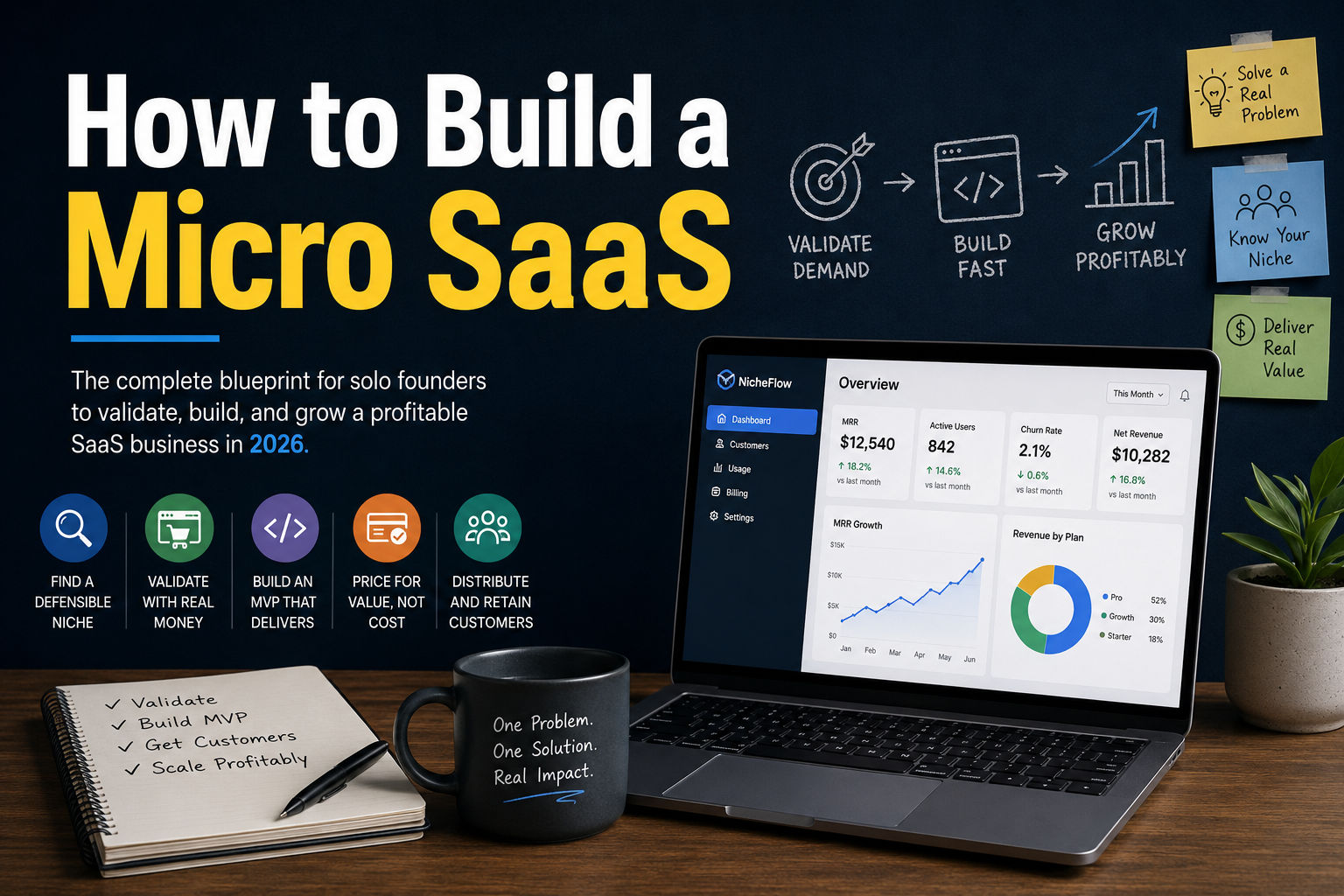
TL;DR: Building a micro SaaS in 2026 is less about writing code and more about finding a problem worth solving, validating demand with real money, and mastering distribution in an AI-dominated discovery landscape. This guide covers every phase from niche validation and modern tech stacks to pricing models and growth so you leave with a complete execution plan, not just inspiration.
Here's a number that should stop you cold: 90% of solo founders never break $1,000 in monthly recurring revenue.
Not because they built bad software. Not because they lacked technical skill. Because they built the wrong thing and found out too late.
The micro SaaS space in 2026 is simultaneously the most accessible and most brutally unforgiving it has ever been. AI coding tools have eliminated the barrier to building software. Which means the differentiator is no longer whether you can write a working app. It's whether you've identified a problem painful enough that someone will actually pay to have it solved.
The global SaaS market is heading toward $465 billion. The micro SaaS segment specifically is on track to grow 30% annually, reaching $59.6 billion by 2030. The opportunity is real. But the playbook has changed completely.
This guide is the one you read before you write a single line of code.
The Micro SaaS Landscape in 2026: What's Actually Happening
Defining the Modern Micro SaaS
A micro SaaS is a small, niche software product built and operated by one person or a very small team typically under five people targeting a specific vertical problem with a subscription revenue model. Think: a CRM built exclusively for tattoo artists. Compliance reporting software for medical spas. Invoice automation for independent landscapers.
What separates micro SaaS from traditional SaaS isn't scale it's philosophy. The micro SaaS model is deliberately capital-efficient. No VC money. No massive engineering teams. High profit margins (often 60–80%) because the infrastructure is lean and the problem is specific enough that churn stays low.
The revenue ceiling most founders shoot for is $5,000–$50,000 MRR. That's not a consolation prize. At 70% margins on $25K MRR, you're running a $210K/year business with no boss, no investors, and no permission required.
Why "AI Wrappers" Are Dead and What to Build Instead
Two years ago, founders were launching products that did nothing but pass a text prompt to OpenAI and return the response with a nicer UI. Summarizers. Basic copy generators. AI-writing detectors.
That era is over.
These features now live natively inside Notion, Google Workspace, and the Apple ecosystem. The consumer willingness to pay for generic AI functionality has collapsed to zero. Any horizontal AI wrapper a product targeting "everyone" with no deep vertical focus is effectively a dead business model before it launches.
The models that are winning in 2026 are radically different:
- Vertical AI SaaS software that speaks a specific industry's language, maps to niche data structures, and handles regulatory requirements no general LLM understands natively.
- Agentic workflow tools products that don't give users a chat box, they deliver an outcome. Scrape a competitor's pricing, match it against your catalog, update your Shopify store. Automatically.
- Data moat products niche databases and benchmark dashboards aggregating proprietary data that raw AI can't generate. A freelance healthcare tech salary database. An industry-specific conversion benchmark tool.
- Content transformation engines tools that genuinely transform one piece of media into platform-optimized formats, not just re-post the same text everywhere.
The pattern across all of these? The product is embedded inside the user's workflow, not sitting adjacent to it. That distinction is everything.
Step 1: Finding a Defensible Niche (Before You Get Excited About the Product)
The most dangerous phrase in bootstrapped software is "I have an idea."
Ideas are worthless. Problems are valuable. More specifically: expensive, recurring problems that a specific type of business is already paying to manage poorly.
The Power of Vertical Specificity
The more specific your target, the higher your defensibility. A generic project management tool competes with Asana, Monday, and ClickUp — all VC-backed with unlimited runway. A project management tool built specifically for independent event planners, with venue tracking, vendor CRM, and day-of timeline automation baked in? That competes with a spreadsheet and a prayer.
Vertical specificity creates moats in three ways:
- Workflow depth Your product maps to the exact operations of a specific role, not a generalized version of those operations.
- Language resonance Your marketing uses the exact terminology your users use. "Decorator packages" not "service tiers."
- Switching costs Once a user's data and workflows are inside a product built for their industry, migration is psychologically and practically expensive.
Building Data Moats and Community Moats
The two most defensible assets a micro SaaS can build aren't features they're data and community.
A data moat means your product aggregates information that becomes more valuable as more users contribute to it. Benchmark dashboards, anonymized industry salary data, aggregate performance metrics. An LLM can't replicate this. Competitors can't easily clone it.
A community moat means your users help each other, share workflows, and build habits around your product as the gathering point. The software becomes secondary; the community is the product. Churn in community-anchored products drops dramatically because leaving the software means losing the network.
Step 2: Validating Demand Before Writing Code
This is the section most founders skip. It's also the section most responsible for the 90% failure rate.
The Niceness Gap and Why Soft Validation Will Kill You
Telling potential customers about your idea and asking if they'd use it is not validation. It's a social exercise.
People are polite. They'll say "that sounds amazing" because they don't want to hurt your feelings. They'll join your waitlist because it costs them nothing. This creates what's called a Niceness Gap a false signal that disguises total lack of genuine demand.
Real validation has exactly one reliable signal: money.
The Fake-Door Test
Build a landing page. Make the product sound real and fully operational. Include a specific price point not "pricing coming soon." Drive targeted traffic to it. When a user clicks to purchase or start a trial, show them a modal explaining you're in private beta and capture their email.
Measure the conversion rate from targeted traffic to that click. If you're above 5% on paid traffic, you have a statistically meaningful signal. Below 5%, you have a messaging or positioning problem, or worse — no market.
The key requirements for an effective fake-door test:
- Speak the customer's language. Mine G2 reviews and Reddit complaints in your target niche. Use the exact words frustrated users use to describe their pain.
- Name a real price. Validating a free product tells you nothing.
- Use paid traffic. Organic traffic from your network is filled with polite supporters. Strangers clicking a paid ad are a true test.
Pre-Selling: Proof You Can't Fake
For higher-ticket B2B tools, don't just measure clicks collect actual money. Offer early-access pricing, a lifetime deal, or "design partner" status that comes with heavy involvement in shaping the product.
Products like Encharge.io secured nearly $4,000 in pre-orders using only a guide and a prototype. Content Snare sold 25 copies for over $1,200 using two screenshots. No backend. No code. Just a landing page and a proof of demand.
If you can't get someone to pay before you build it, that's not a sign to build faster. It's a sign to pivot.
The Concierge MVP
If you can't pre-sell the software itself, manually deliver the outcome first.
Promise an AI-generated weekly competitive intelligence report? Send it manually for the first 10 customers. Promise automated onboarding flows? Build them by hand in Notion, then charge for the result.
This approach exposes every edge case, every real-world complexity, every assumption that would've cost weeks of misguided development. When the manual process becomes overwhelming, that's when you write the automation.
Step 3: Selecting the Right 2026 Micro SaaS Tech Stack
The goal of a micro SaaS tech stack is maximum leverage for a single operator. You need to move fast, maintain parity with teams 10x your size, and avoid accumulating technical debt that will paralyze you at $5K MRR.
The No-Code Prototyping Route and Its Ceiling
Platforms like Bubble, Softr, and Webflow are genuinely useful for initial prototyping and fake-door testing. They let non-technical founders validate ideas and demonstrate workflows visually.
But they carry serious risks:
- Vendor lock-in Your entire product lives on a platform you don't control. A pricing change or policy shift can destroy your business overnight.
- Scaling ceiling Most no-code platforms struggle with complex relational data, advanced API orchestration, or high-volume usage at reasonable cost.
- IP risk Your core logic often lives inside a third-party system. Exporting it cleanly is rarely as simple as advertised.
No-code is a prototyping tool, not an architecture for a real business.
The Developer Stack: What Solo Founders Are Actually Using to Scale
The consensus among bootstrapped founders scaling to meaningful MRR in 2026 is strikingly consistent. One stack handles the vast majority of successful products:
Layer Tool Why It Works Frontend & API Next.js (TypeScript) Single codebase; App Router simplifies data fetching Styling & UI Tailwind CSS + shadcn/ui Copy-paste components; zero custom CSS debt Database & Auth Supabase (PostgreSQL) Handles auth, DB, storage, and Row Level Security Hosting Vercel Zero-config Next.js deployment; edge functions Payments Stripe Usage-based billing; global tax compliance
This isn't a theoretical preference. It's the architecture used by the majority of bootstrapped founders achieving $10K–$100K MRR as solo operators. The mental model is simple: one codebase, one database, one deployment pipeline.
Calculating API Costs Before You Build
If your product uses AI APIs, this isn't optional it's existential.
Founders have been blindsided by API bills when a single power user triggers an expensive agentic loop. The protocols that protect you:
- Dynamic model routing: Use cheap, fast models (GPT-4o mini, Claude Haiku) for classification and formatting. Reserve expensive reasoning models only for complex logic.
- Context caching: Don't re-process the same documents repeatedly. Cache results aggressively.
- Hard usage limits: Implement daily token caps per user before you launch. Not after your first $3,000 surprise invoice.
Price your product based on value delivered but model your margins based on worst-case API consumption.
Step 4: Building the MVP in 30 Days
Once you've validated demand and chosen your stack, development begins. The discipline required here is subtraction, not addition.
Feature Constriction: Build Only the Value Core
Your MVP has exactly one job: deliver the single outcome that made someone willing to pay. Everything else is a distraction.
Delete the analytics dashboard. Remove the custom branding options. Kill the secondary features you added because they seemed "nice to have." Every additional feature:
- Increases build time
- Introduces new bugs
- Dilutes the activation path
- Increases cognitive load for new users
A 30-day MVP should solve one problem, load fast, and have a clear path from signup to value in under five minutes.
Avoiding Early Technical Debt
Technical debt in an early-stage product isn't always bad but structural technical debt is fatal. Shortcuts in architecture (skipping Row Level Security, hard-coding business logic, ignoring database indexing) create problems that don't surface until you have paying customers and no time to fix them.
Use Supabase's built-in RLS from day one. Type your API responses. Don't couple your frontend directly to your database logic. These aren't premature optimizations they're the architectural decisions that prevent a complete rewrite at $8K MRR.
Step 5: Legal Infrastructure and Compliance
This section is almost universally ignored by first-time founders, and almost universally becomes a crisis later.
Entity Formation: LLC vs. Sole Proprietorship
For US-based founders, operating as a sole proprietor means your personal assets are fully exposed to business liability. Form an LLC. It costs $50–$500 depending on state, takes a weekend, and protects everything you own outside the business.
For non-US founders targeting US customers, a Delaware or Wyoming LLC provides the legal structure and bank account access needed to work with Stripe, AWS, and enterprise B2B customers who require vendor contracts.
Data Compliance: GDPR, SOC 2, and HIPAA
If you handle user data (and you will), compliance is not optional. It's the difference between a deal closing and a deal dying.
- GDPR: Required for any EU user data. Supabase provides GDPR-compliant infrastructure, but your application logic must implement proper consent flows, data deletion capabilities, and privacy policies.
- SOC 2: Required by most mid-market and enterprise B2B buyers before they'll sign a vendor agreement. SOC 2 Type I certification is achievable for solo founders using compliance automation tools like Vanta or Drata in 2–4 months.
- HIPAA: Required if you're building anything in the healthcare vertical. Non-negotiable. Supabase offers HIPAA-compliant infrastructure; ensure every third-party integration is also covered by a BAA (Business Associate Agreement).
Outsourced Development and IP Ownership
If you hire freelancers to help build, every contract must include a "Work for Hire" clause. Without it, the developer who wrote your authentication logic may legally own that code. This creates vendor hostage situations that have destroyed early-stage products.
Work-for-hire clauses are standard, free to add to any contract, and absolutely mandatory.
Step 6: Pricing Strategy and Monetization
Traditional flat-rate SaaS pricing is cracking under the weight of variable API costs. A user on a $20/month flat plan who runs 500 AI operations daily generates negative margins.
Hybrid Billing: The 2026 Standard
The model that's winning is hybrid billing:
- A base subscription fee for platform access and standard features
- A metered credit allotment for AI-powered or compute-intensive actions
- Overage fees or auto-upgrades when credits are exhausted
This architecture aligns your cost of goods sold directly with revenue. Heavy users pay more. Light users stay on a sustainable tier. Nobody gets a surprise bill and cancels.
70% of SaaS businesses are actively transitioning to usage-based or hybrid models. Build it in from the beginning using Stripe's metered billing API.
The Freemium Trap
Free tiers feel like a growth hack. In practice, for bootstrapped micro SaaS products, they're usually a resource drain.
Free users consume support, infrastructure, and your attention. They rarely convert. And a free tier signals to paying users that maybe they're overpaying which erodes your pricing power.
The contemporary approach: time-bound free trials (7 or 14 days, full product access) with credit card required, or a sharply limited free tier that excludes the product's core value. Charge from day one. The feedback you receive from users with actual economic stake is the only feedback that matters.
Price on Value, Not Cost
The most common micro SaaS pricing mistake is using API costs or server fees to set price. That's cost-plus pricing, and it's a ceiling on your revenue.
Price on the outcome you deliver. If a compliance tool saves a healthcare administrator 8 hours of manual reporting per week, and that administrator bills at $60/hour, you've delivered $480/week in value. A $299/month subscription is a steal. Anchor to the value, not the cost.
Step 7: Growth, Distribution, and the Answer Engine Economy
Here's the hard truth: in 2026, building the software is the easy part. Getting it discovered is where founders succeed or disappear.
Traditional SEO Is Necessary But No Longer Sufficient
Publishing helpful content still works. But traditional keyword-focused SEO now competes with a completely new distribution channel: AI answer engines.
Gartner has tracked a 25% decline in traditional search volume as B2B buyers increasingly turn to ChatGPT, Perplexity, and Google AI Overviews to build vendor shortlists. If your product isn't being cited by these systems, you're invisible to a growing segment of your market.
This isn't a future concern. It's happening now.
Answer Engine Optimization (AEO): The New Playbook
AI engines don't rank pages. They synthesize answers from structured, authoritative sources. To be included in those answers:
Structure content for extraction:
- Lead with a direct answer in the first 200 words AI retrieval systems weight document beginnings heavily.
- Use explicit H2/H3 headings formulated as questions your customers actually ask.
- Implement JSON-LD Schema markup:
SoftwareApplication,FAQPage, andBuyActionprovide machine-readable product data AI crawlers can extract without ambiguity.
Replace adjectives with data: AI models ignore marketing language. They extract statistics, benchmark figures, and verifiable claims. "Powerful tool" gets ignored. "Reduces reporting time by 73% for HIPAA-covered entities" gets cited.
Build proof density across platforms: LLMs weight brands mentioned organically across independent sources more heavily than self-reported claims. A product mentioned on G2, Reddit, relevant directories, and YouTube creates "proof density" that AI systems trust. Your own website alone doesn't.
Community-Led Distribution: The Long Game
Reddit has become the most critical distribution and citation surface for bootstrapped products. The catch: overt promotion gets you shadowbanned and algorithmically penalized.
The approach that works: map the subreddits where your target customer congregates. Spend weeks providing genuine, high-signal answers. Never mention your product initially. When an organic community member eventually asks about tools for your problem domain and you link to your product in context, that interaction carries enormous weight with LLM retrieval systems far more than any ad placement.
Product-Led Growth for Solo Founders
PLG doesn't require a massive free tier. It requires embedding value delivery into the acquisition flow.
A well-designed template, a free competitive analysis export, or a one-time free audit that uses your product's core functionality serves double duty: it demonstrates value and generates data for re-engagement campaigns. The activation event the moment a user first experiences your product's core value should happen before they enter their credit card.
Programmatic SEO at Scale
For capturing long-tail, high-intent queries without manual content creation, programmatic SEO remains highly effective.
The pattern: take a structured data set (software integrations, industry verticals, location data) and pair it with optimized page templates. A micro SaaS serving HR teams can generate landing pages for every combination of role + industry + tool integration. "Compliance tracking for fintech HR managers using BambooHR" is a query no competitor is targeting manually.
Companies have achieved over 200% traffic growth by programmatically targeting long-tail variations. When structured correctly and populated with genuinely unique data, these pages capture precise buyer intent at scale.
Common Mistakes That Kill Micro SaaS Products
Building in isolation. Six months of heads-down development before showing anyone the product. By launch, you've optimized for assumptions.
Selling to consumers. The math on B2C SaaS doesn't work for solo founders. You need millions of users to generate meaningful revenue, and consumer churn is brutal. Sell to businesses.
Ignoring churn. Every cancellation is a free product review from someone with no incentive to be polite. Exit interviews with churned users are the highest-ROI activity at any stage.
Skipping legal structure. No LLC, no IP contracts, no privacy policy. This is fine until it's catastrophic.
Pricing for free. Launching free to "build an audience." All you build is an audience that expects free things.
Positioning next to the workflow instead of inside it. If your product requires users to export data, run a process, and re-import results, it will be abandoned. Eliminate every step between the user's existing system and the value your product delivers.
The Exit Option: Micro SaaS Acquisitions
Building a micro SaaS to sell is a completely legitimate strategy and the market for it has matured significantly.
Bootstrapped, profitable micro SaaS products are regularly acquired on platforms like Acquire.com at multiples of 3.5x to 4.35x trailing twelve months (TTM) profit. A product generating $8,000 MRR at 65% margins produces roughly $62,400 in annual profit. At a 4x multiple, that's a $250,000 acquisition.
For a solo founder who built the product in 90 days and operated it for a year, that's an exceptional return. The key metrics acquirers evaluate: MRR consistency, churn rate, net dollar retention, and revenue concentration (no single customer representing more than 20% of revenue).
Knowing your exit options changes how you build. Systems that are well-documented, cleanly architected, and not dependent on your personal involvement are worth significantly more.
Frequently Asked Questions
How much does it cost to start a micro SaaS? Initial costs are extremely low. The standard 2026 stack — Next.js deployed on Vercel, Supabase for database and auth, Stripe for payments has a free tier covering most early-stage usage. Realistically, you'll spend $0–$50/month on infrastructure before you're generating revenue. The main cost is time.
Can a non-technical person build a micro SaaS in 2026? Yes, with caveats. AI coding tools like Lovable and Bolt.new allow non-developers to scaffold full-stack applications using natural language. But launching a production product that handles real customer data requires understanding enough about security, database design, and API architecture to avoid catastrophic mistakes. Most successful non-technical founders hire a developer for architecture and security, then manage operations themselves.
How long does it take to reach $10K MRR? Median time for bootstrapped founders who successfully reach $10K MRR is 12–24 months. Founders who validate demand before building, target B2B, and build distribution systems from day one reach it faster sometimes in 6–9 months. Founders who build first and market later rarely get there.
What's the best niche for a micro SaaS in 2026? High-value niches share three characteristics: the target customer is a business (not a consumer), the problem is expensive or time-consuming, and the existing solutions are generic tools that don't understand the industry. Sectors showing strong demand include healthcare operations, legal practice management, construction project tracking, independent restaurant back-office, and compliance tooling for fintech.
Should I build with no-code or custom code? Use no-code for validation and fake-door testing. Use custom code for anything you intend to charge for at scale. The vendor lock-in and scaling limitations of no-code platforms create serious risks for real businesses.
How do I get my first 10 customers? Don't launch publicly recruit manually. Identify 20 people with the exact problem you solve. Contact them directly. Offer a significant discount or design partner involvement in exchange for feedback and payment. Your first 10 customers should be people you spoke to before you built the product.
Final Thoughts
The 2026 micro SaaS opportunity is real. The market is growing. The tools have never been better. A solo founder with no outside capital can genuinely build a $20K–$50K MRR business in a year.
But the playbook has changed in ways most guides haven't caught up to.
Building is cheap. Distribution is hard. AI has commoditized code, not market insight. The founders who succeed in this environment are the ones who fall in love with a specific customer's specific problem and become obsessed with putting the solution directly inside the workflow that's causing the pain.
Stop building for the portfolio. Start building for the check.
Pick one niche. Talk to 20 people in it. Find the problem they're losing money or hours to right now. Build the smallest possible thing that fixes it. Charge for it before it's finished.
Everything else in this guide is execution detail. That's the whole model.