How to Scale a Bootstrapped SaaS from $0 to $10,000 MRR (The Ultimate Playbook)
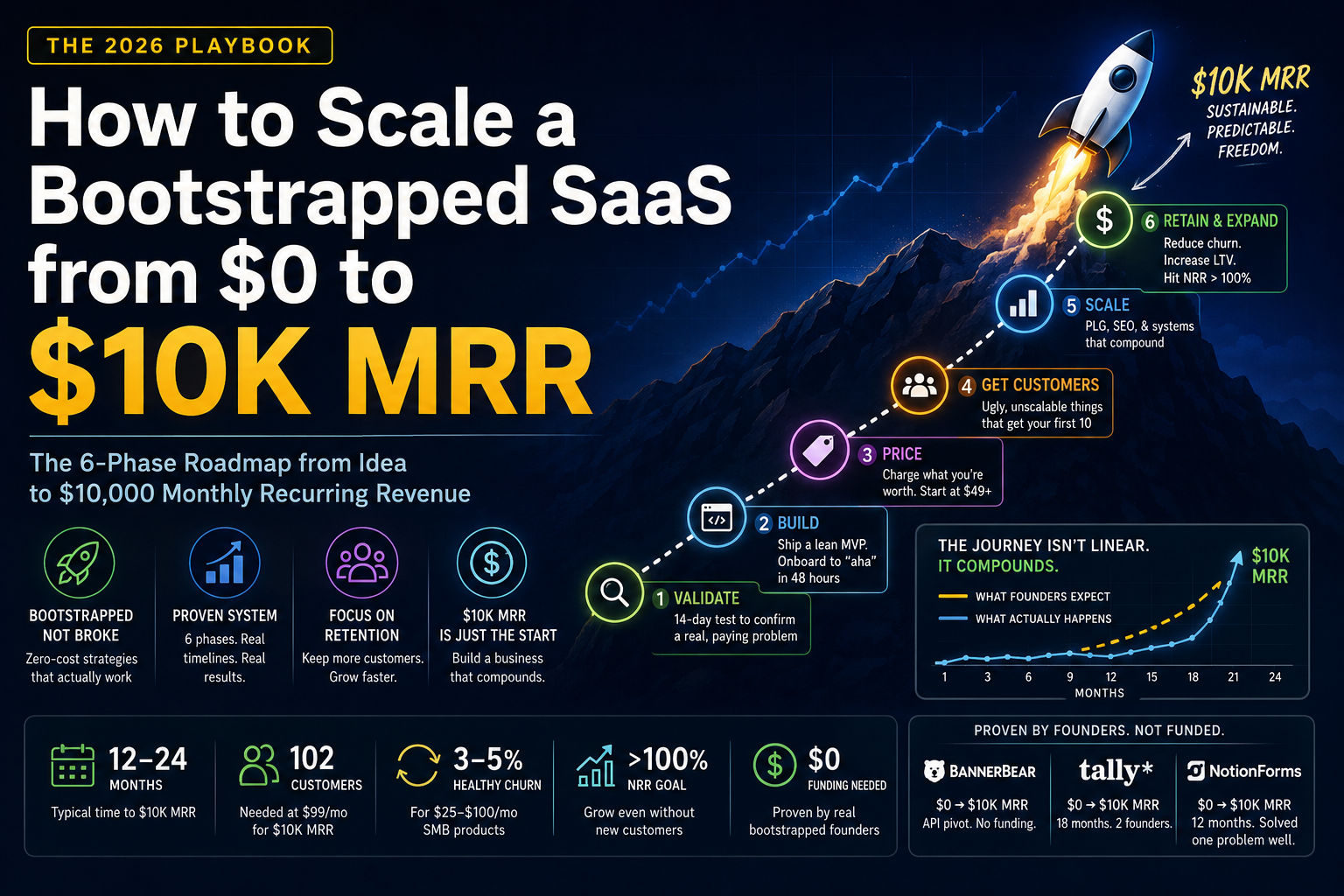
TL;DR: Scaling a bootstrapped SaaS to $10,000 MRR in 2026 isn't about writing complex code. It’s about getting people to buy. This guide gives you the exact 6-step playbook to validate your idea without code, build a free MVP, find your first 10 customers using cold email, set the right price ($49/mo minimum), and scale using programmatic SEO. Stick to the math, survive the slow months, and execute.
You spent six months building. You launched on a Tuesday. By Friday, you had four users and three of them were your roommates.
This is the SaaS founder's nightmare. And right now, someone on Reddit's r/SaaS is posting about it. "Launched my first SaaS. 0 users. What now?" The replies pour in, but most of the advice is too vague to be useful: "Do content marketing." "Join communities." "Build in public."
None of that tells you what to do on Monday morning.
This guide does.
The $10,000 MRR milestone is the number that separates a side project from a real business. It's not an arbitrary goal it's the point where your product proves it can survive without you forcing it to. It means people are paying you, month after month, without you asking them to.
Getting there is hard. It usually takes 12 to 24 months. Most people quit in month four when nothing seems to be working. But the ones who make it follow a pattern and that pattern is what you're about to read.
The Brutal Truth About Building SaaS in 2026
Here's what's changed in the last two years: building is no longer the hard part.
AI coding tools like Cursor have compressed MVP development from months to weeks. The technical barrier is effectively gone. Anyone with a problem to solve and a few weeks of focused work can ship a functioning product.
Which means the new bottleneck is distribution. Getting your product in front of the right people, keeping them, and charging enough to make it worth your time that's where most founders fail now.
There's also a new graveyard to avoid: AI wrappers. Products that just slap a chat interface on top of GPT-4 are churning at rates above 45% per month. Users try them once, shrug, and cancel. The sustainable opportunities in 2026 are in boring, specific, vertical software compliance tools, internal operational systems, workflow automation for a niche industry. Unglamorous stuff. High-retention stuff.
Keep that in mind as you read this playbook.
Phase 1: Validate Before You Build (The 14-Day Test)
The single most expensive mistake in SaaS is building the wrong product. Not shipping slowly. Not pricing wrong. Building something nobody needs badly enough to pay for.
The fix is embarrassingly simple: talk to people before you write code.
Start with the problem, not the product. The question isn't "will people like my idea?" It's: does this problem happen weekly or daily? If people only encounter this pain occasionally, you'll spend your whole life reacquiring customers who churn the moment they solve their one-off problem.
Next, check for competition. This sounds counterintuitive, but zero competition is usually bad news. It means nobody has found a paying market here. You want to see competitors. They're proof that people are already spending money to solve this problem and your job is to find the slice of that market they're underserving.
Then test whether you can actually reach your audience. Build a landing page in a day. No product, no code just a clear description of what you're building and a signup form. Run it through the communities where your target users hang out. If you can't get 10% of visitors to submit their email to hear more, that's a signal. It doesn't mean kill the idea, but it means something is off with either the messaging or the audience.
Spend two weeks on this before you build anything. Those 14 days will save you six months.
The benchmark: Out of 20 one-on-one conversations with potential users, at least 15 should describe the same specific pain in their own words. If you're hearing 20 different problems, you don't have a product you have a consulting practice.
Phase 2: Build the MVP Right (and Fast)
Once validation gives you a green light, move quickly. But quickly doesn't mean sloppily especially when it comes to the first 10 minutes of a user's experience.
The zero-cost 2026 stack for solo founders:
- Next.js — frontend and backend in one framework
- Supabase — database, auth, and storage with a generous free tier
- Vercel — deployment, free until you scale
- Stripe — payments, because Paddle is better for global taxes but Stripe is simpler to start
- Resend — transactional email that actually reaches inboxes
You don't need anything else to get to $10K MRR. Don't let tooling decisions become a procrastination trap.
The onboarding trap most founders miss: If a user signs up and gets confused in their first session, they leave. Not tomorrow right now. You need to get them to an "aha moment" within 48 hours.
What does that look like in practice? If your product analyzes something, use AI to pre-fill the first analysis automatically. If it manages something, walk the user through creating their first item in under two minutes. Never make someone read documentation to understand why your product exists.
And set up email triggers from day one. Not newsletters behavioral emails. "You haven't logged in for 3 days. Here's what's waiting for you." Organic return rates for unproven apps are nearly zero. You have to pull people back with genuine value, not guilt.
Phase 3: Price Like the Business You Want to Be
This is where a lot of technically gifted founders leave money on the table or actively destroy their business.
The $9/month trap is real. Jon Yongfook, founder of Bannerbear, launched his first product at $9/month. It attracted a flood of high-maintenance customers, generated almost no revenue, and nearly killed the business. He later pivoted to an API-first product, exited consumer marketplaces entirely, and reached $10K MRR.
Here's the math that should terrify you:
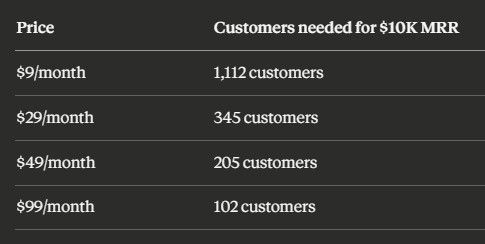 Do you want to support 1,112 users who are all price-sensitive, high-churn, and happy to submit three support tickets per month? Or 102 customers who budget for software seriously and stick around?
Start at $49/month minimum for a B2B tool. If your ICP is a business, $49 is a rounding error in their budget. It filters out the "just curious" crowd and attracts buyers who actually need what you built.
For 2026, also think about hybrid pricing. If your product uses AI on the backend, flat-rate pricing will eventually eat your margins. Consider a base fee plus usage-based consumption (API calls, AI credits, processed records). It protects you as AI compute costs scale up with usage.
One more tactic: require a credit card before the free trial. Yes, this reduces trial volume. But a user who enters their card number wants to solve a problem. A user who signs up without one is window shopping. Your conversion rate to paid will improve. Your support burden will shrink.
Phase 4: Getting Your First 10 Customers
Nobody is coming to your website. Not yet. You have to go get them.
The best founders in the $0 to $1K MRR phase do ugly, unscalable things. They DM strangers. They post in niche Slack groups. They email people directly. This feels embarrassing. It also works.
The 4-week active launch campaign:
Week 1 - Warm outreach. Make a list of everyone in your professional network who fits your ICP. Former colleagues. LinkedIn connections. People you've talked to about this problem. Send 20 to 30 personal messages. Not a mass email an actual human note. Reference something specific. Ask if they know anyone who'd benefit, not just if they want to buy.
Week 2 - Community distribution. Identify three to five online communities where your target user hangs out (subreddits, Slack groups, Discord servers, Facebook groups). Don't spam them. Contribute genuinely for a week, then share your product as a member of the community, not a marketer crashing the party.
Week 3 - Systematic directory launches. This is the move most founders skip and shouldn't. There are 40 to 60 startup and product directories worth submitting to — Product Hunt, BetaList, SaaSHub, AlternativeTo, and dozens of niche ones. A study of 75 early-stage SaaS companies found that systematic directory launches generate 50 to 100 signups for a $0 to $200 investment and convert to 5 to 12 paying customers on average. Not life-changing. But first customers.
Week 4 - Cold outreach. Once you've proven the product with warm leads, expand to cold email. Use a secondary domain (never your main domain), set up SPF/DKIM/DMARC, and send plain text emails under 100 words. No HTML. No logos. No tracking pixels. Subject lines under four words. Your goal is one response "tell me more" not a closed deal in one email. A 3% to 6% reply rate means your targeting is right.
Phase 5: Scaling from $1K to $10K MRR
Once you have paying customers and the funnel converts, the game changes. You need acquisition channels that compound, not ones that require constant manual effort.
Product-Led Growth (when the product is the marketing)
Tally.so, the form builder, reached $10K MRR in 18 months with a two-person team. Their secret wasn't clever ads it was a watermark. Every free-tier form had "Made with Tally" at the bottom. Every user who embedded a form on their website was advertising Tally to their visitors.
That's PLG. The product markets itself by being used. If you can build this kind of loop into your product branded free output, embeds, "powered by" links do it. Tally's 20,000 free users converting at 3% gave them 600 paying customers and a revenue base where no single cancellation mattered.
Ecosystem leverage (build on top of something people already love)
NotionForms reached $10K MRR in 12 months by solving one specific problem for Notion users. They didn't need to educate the market on why forms matter Notion's massive user base already got it. They just showed up in every search for "Notion forms."
Identify the platform your target user is already obsessed with. Build the thing that makes that platform better. You inherit the search demand, the community, and the credibility.
Programmatic SEO (when you're ready to scale content)
Traditional content marketing is too slow for founders with limited runway. The faster path is programmatic SEO building thousands of highly specific landing pages using structured templates.
Zapier used this to dominate automation searches. They created a page for every possible app-to-app integration: "Connect Slack with Trello," "Connect Gmail with Notion," and so on. Thousands of pages, each targeting a long-tail search with high intent.
For your SaaS, think about: best [tool] alternative for [use case], [tool] vs [competitor tool], how to do [task] with [your category]. These searches come from people actively trying to solve a problem and comparing options. They convert. And they're far easier to rank for than broad industry keywords.
One key formula: Revenue Per Search (RPS) = (Monthly Search Volume × Click-Through Rate × Conversion Rate × ARPA). A keyword with 200 monthly searches but 8% conversion and $99 ARPA is worth far more than a keyword with 10,000 searches and 0.1% conversion.
Phase 6: Keeping What You Earn (Churn Is the Hidden Enemy)
You can't scale a leaky bucket.
Here's a number most founders don't know: 40% to 60% of all voluntary cancellations happen in the first 90 days. If a user doesn't get a clear, undeniable win within 48 hours of signing up, their probability of staying collapses. This is why onboarding isn't a nice-to-have it's the most important growth lever you have.
Churn benchmarks for 2026:
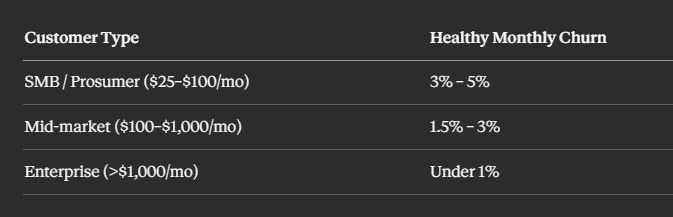 If your numbers are worse than these, more marketing won't save you. Fix retention first.
Involuntary churn is sneaky. About 25% of all customer losses aren't people choosing to leave they're failed credit card payments. Expired cards. Banking blocks. This revenue is recoverable. Set up automated dunning sequences that retry payments and send personal-looking emails asking the customer to update their card. A well-built dunning system recovers over 50% of involuntary churn.
Watch the warning signs early. Between 70% and 80% of users who eventually churn show measurable warning signs at least 30 days before canceling login frequency drops, core features go unused, API calls stop. Instrument your app to detect these patterns and trigger an automated outreach sequence. "Hey, noticed you haven't used [feature] lately. Want a quick walkthrough?"
The goal is a Net Revenue Retention (NRR) above 100%. That means the revenue from existing customers grows even without adding new ones through upgrades, seat expansions, and usage-based billing. When you hit NRR above 100%, your business grows even if you stop acquiring new customers entirely. That's when SaaS becomes a real asset.
The Valley of Death: Months 4 Through 6
Let's talk about the part nobody puts in their case study.
Around month four or five, something demoralizing happens. You have some customers. You're putting in the work. But the growth feels painfully slow. $800 MRR becomes $950 MRR. Then $1,100. Then maybe $1,050 as someone churns.
Most founders quit here. The numbers feel too small relative to the effort. There's a common saying in founder communities: "the valley of death." It's the period where compounding hasn't kicked in yet, but you've already run out of the initial momentum from launch.
This is a math problem, not a product problem. In subscription businesses, revenue compounds like interest. A 15% month-over-month growth rate on $1,000 is only $150 gained. That same rate on $5,000 is $750. The early months feel slow because the base is small not because the model is broken.
The cure is a 12-month minimum commitment. Before you evaluate whether the business can work, give it a year of genuine effort. Track your week-over-week growth rate, not just the absolute number. If your percentage is holding steady or improving, the compounding will catch up.
Common Mistakes That Kill SaaS Businesses Before $10K MRR
- Building before validating. Spending months on product before confirming distribution viability.
- Pricing at $9/month. Attracting high-churn, low-budget users who kill your margins and energy.
- Running paid ads before PMF. CAC ranges from $150 to $500 in B2B. Spending that on a leaky funnel is just burning cash.
- Skipping onboarding. Users who don't get a win in 48 hours don't come back.
- Vanity keyword SEO. Writing for high-traffic, low-intent keywords instead of bottom-of-funnel searches that actually convert.
- Building alone and invisible. Not sharing the journey publicly means missing the distribution flywheel that case studies like Tally benefit from.
The Path Forward
The $0 to $10K MRR journey is not about finding a secret hack or catching a viral wave. It's about doing the boring, foundational work correctly in the right order.
Validate the problem first. Build fast but onboard well. Price for sustainability. Get your first customers manually, then build channels that compound. Fix churn before you scale. And commit to at least 12 months before you judge whether it's working.
The founders who hit $10K MRR aren't necessarily smarter than the ones who quit in month four. They just understood what phase they were in and kept moving.
Start with the validation. Everything else follows from there.