How He Built a $14K/Mo AI SaaS Without Writing Code
 It’s a Tuesday afternoon. If you open YouTube, you might see a man sitting at his desk, listening to lo-fi hip-hop.
He is not typing code. Instead, he is talking to his computer. He describes a complex login feature in plain English. Seconds later, autonomous AI agents write the code, test it, and push it live. He is doing this live, in front of thousands of people, with his Stripe revenue dashboard openly displayed on the screen.
This is Matthew Miller. And this is Day 165 of his public quest to hit $1,000,000 in revenue.
Matthew is the founder of BridgeMind, an operating system for a new era of software development called "vibe coding." By ditching traditional marketing and live-streaming his raw, unfiltered building process, he has grown BridgeMind to nearly $15,000 in Monthly Recurring Revenue (MRR), jumping 139% in a single month.
We broke down exactly how a former Yiddish translator turned a massive shift in programming into a booming SaaS business and how he acquires customers for $0.
The Origin: Why Translating Yiddish Led To Building AI Software
Matthew’s path to tech was completely backward. He didn't study computer science. He has a Master’s in Linguistics and spent years working as an expert Hebrew and Yiddish translator.
Eventually, he dropped out of Purdue to pursue entrepreneurship. In late 2023, he decided to teach himself how to program. As AI models like Claude and GPT got smarter, Matthew had a massive realization that became his unfair advantage:
Coding is no longer about syntax. It is just translation.
Traditional developers translate human ideas into rigid machine languages (like Python). But with AI, natural language is the programming language. Matthew’s deep background in linguistics meant he was world-class at structuring complex thoughts and writing clear prompts.
He realized he didn't need to be the fastest typist to build software. He just needed to be the clearest communicator.
The Problem: AI Was Smart, But The Tools Were Broken
Matthew started building his previous startup using early AI tools. But he hit a wall.
The problem wasn't that the AI was dumb. The problem was the workflow. He had to constantly copy-paste information between his notes, his code editor, and ChatGPT. The AI kept "forgetting" the rules he set. The context window kept breaking.
He realized that chatting with a bot and copy-pasting code isn't real AI development. It’s just a better Stack Overflow.
The Solution: Matthew built BridgeMind to fix his own frustration.
Instead of a chat box, BridgeMind is a complete workspace. It includes:
-
BridgeSpace: A desktop environment with a Kanban board. You drag a task (like "build a payment page"), and an AI agent claims it and builds it.
-
BridgeMCP: A shared "brain" server so all your AI tools remember your project’s exact rules and architecture.
-
BridgeVoice: A lightning-fast voice-to-code tool.
He "vibe coded" the first version of the platform using the AI models he was trying to manage. By eating his own dog food, he guaranteed the product solved a real problem.
The Growth Engine: How To Get Customers Without Spending A Dollar On Ads
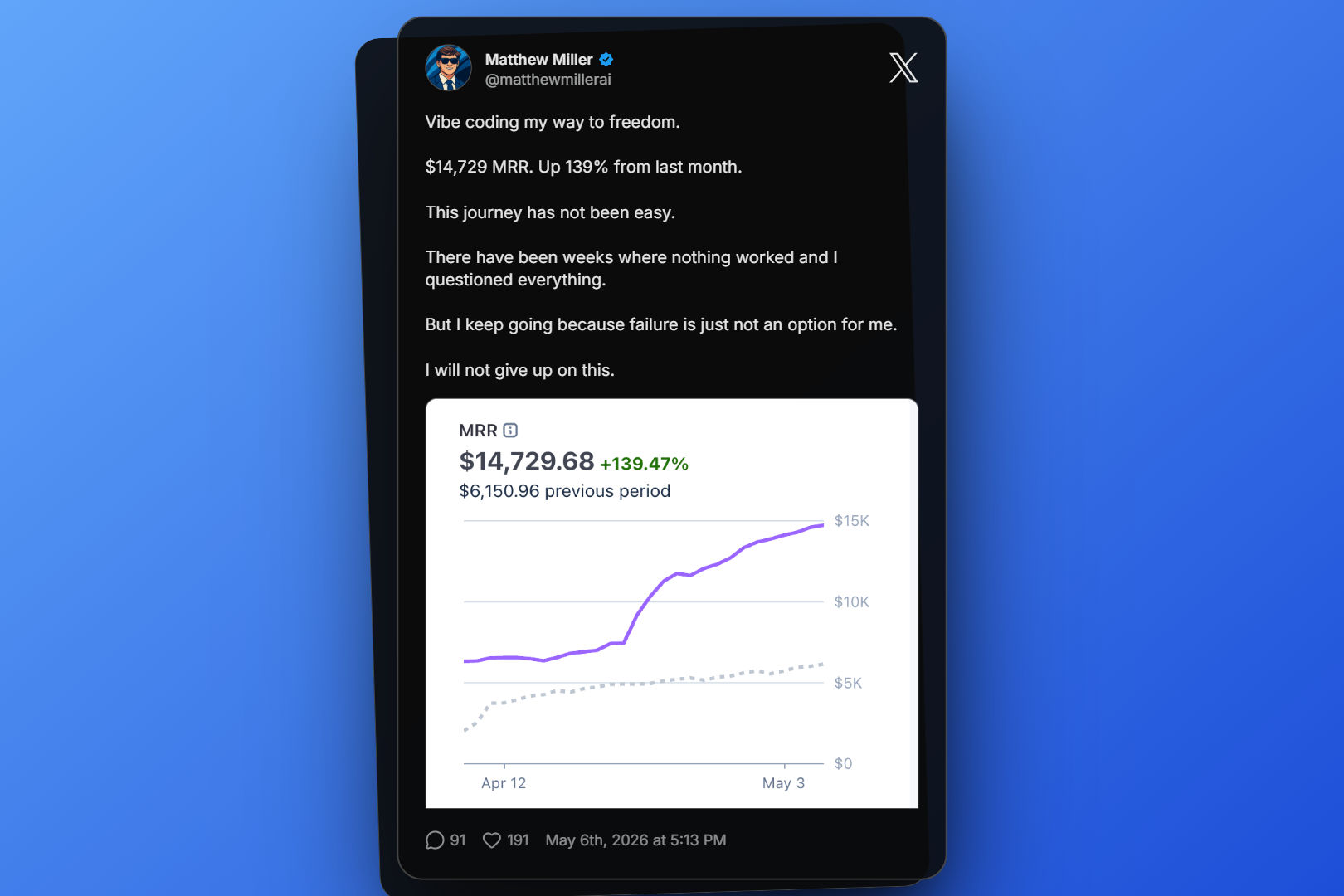 BridgeMind grew to $14K+ MRR and over 70,000 YouTube subscribers practically overnight.
How? Matthew completely ignored traditional B2B SaaS marketing. No paid ads. No polished landing page videos. No cold email spam.
Instead, he built a three-step customer acquisition machine based purely on radical transparency.
Step 1: Top of Funnel (The YouTube Live Stream)
Matthew started a daily YouTube series called: "Vibe Coding an App Until I Make $1,000,000."
He goes live for up to 6 hours at a time. He doesn't edit out the mistakes. He shows the wins (setting up databases in minutes) and the ugly realities (agents hallucinating, APIs breaking). He even shows his exact revenue dropping and rising.
- Why this works: The AI space is full of "gurus" selling theory. Matthew proves his product works by using it live to build a real business. The stream acts as a multi-hour, highly engaging product demo. Viewers watch him build at lightning speed and think, "I need that tool."
Step 2: Middle of Funnel (The Discord Community)
During the stream, he constantly drives viewers to a free Discord server. It now has nearly 10,000 members.
- Why this works: The Discord isn't just a chat room; it’s a working hub. People share their own vibe coding projects, ask for debugging help, and teach each other. It creates a high-retention environment where the primary shared language is Matthew's product.
Step 3: Bottom of Funnel (The Upgrade & Affiliate Loop)
Once users try vibe coding for themselves, they hit the same friction Matthew did early on. They realize they need BridgeMind Pro to orchestrate multiple agents smoothly.
To pour gasoline on this, BridgeMind launched a brilliant affiliate program offering 30% recurring commissions.
- Why this works: Matthew’s audience is full of other indie builders sharing their journeys on Twitter and YouTube. By giving them a 30% cut, he turned his entire customer base into a massive, decentralized sales team. They promote BridgeMind in their own videos to make a side income, driving more traffic right back to the platform.
The "Sniper" Viral Strategy: Manufacturing Luck
You can't plan a viral hit, but you can build the infrastructure for one.
Matthew noticed that AI developers constantly argue about which model is best (Claude vs. GPT, etc.). Traditional benchmarks were useless for real coders.
So, he built a side project: BridgeBench. It was a live leaderboard tracking how well AI models performed on actual, real-world coding tasks (debugging, UI creation, etc.).
In early 2026, a new AI model update came out. BridgeBench immediately detected that the model's accuracy had severely dropped. Matthew posted the raw data on Twitter, declaring the model "nerfed."
The tweet went massively viral and was even retweeted by Elon Musk.
The Reverse-Engineering:
-
Identify a high-emotion debate in your target market (Which AI is best?).
-
Build a free tool that provides hard data to settle the debate.
-
Wait for an anomaly.
-
Publish the anomaly.
This move instantly positioned BridgeMind as the ultimate authority in AI coding and flooded their top-of-funnel with highly qualified developers.
How BridgeMind Operates: The "Agentic" Company
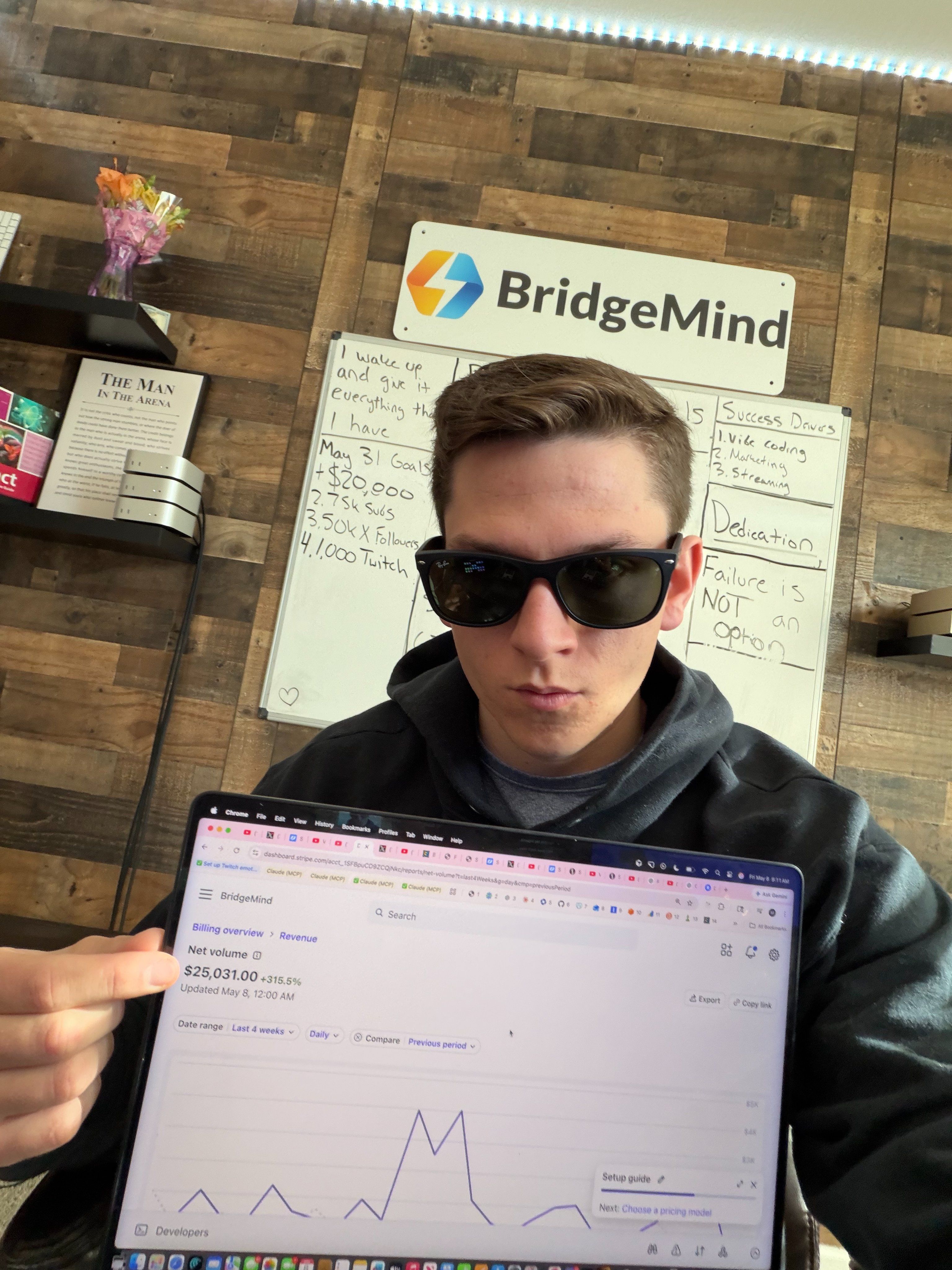 Matthew isn't using his revenue to hire a massive team of junior developers. He runs an "Agentic Organization."
AI agents are treated as autonomous employees. Matthew’s job is no longer writing syntax; his job is architecture and management.
When he does hire humans, he looks for "AI Curriculum Engineers" people whose sole job is to write better prompts and direct agents. This allows a tiny, lean startup to output product updates at the speed of a 50-person enterprise.
4 Key Lessons For Founders
Matthew's journey offers a masterclass in modern SaaS growth. Here is what you can copy:
1. Stop bolting new tech onto old workflows.
If you are building an AI product, don't just use it as a glorified autocomplete tool. Reimagine the entire workflow. Matthew didn't build a better code editor; he built a platform where humans don't type code at all.
2. Sell the sawdust.
Everything Matthew does to run his business (coding, debugging, testing models) is turned into content via YouTube live streams. He monetizes his daily routine. Documenting your real, messy process builds far more trust than a polished blog post.
3. Use radical transparency as a moat.
Showing your Stripe dashboard especially when revenue drops is scary. But it makes your audience root for you. They become emotionally invested in your success. Competitors can copy your features, but they cannot copy the loyal community you build through honesty.
4. Turn your users into your sales team.
BridgeMind’s 30% recurring affiliate program is perfectly tailored to an audience of creators and public builders. If your users already talk about their work online, give them a financial reason to mention your tool every time they do.
Matthew Miller
Founder · BridgeMind
 United States
This story is compiled from public sources and presented in an interview format for a better reading experience.