He Built a $18K/Month AI App in 2 Weeks With ChatGPT
TL;DR: London product manager Kourosh Ghaffari built the AI speech-to-text app Voicy (UseVoicy) in just two weeks using ChatGPT after watching his dad struggle to type emails with one finger. Instead of fighting million-dollar startups for tech workers, he positioned Voicy as a simple "painkiller" for seniors and people with physical disabilities. Today, his solo side project makes $12.4K MRR ($16K–$20K/month total revenue) from 2,000+ paying customers, grown entirely through free Google SEO and a Chrome extension funnel with zero paid ads.
Kourosh Ghaffari
Founder · Voicy (UseVoicy)
 United Kingdom
This story is compiled from public sources and presented in an interview format for a better reading experience.
1. The 30-Second Snapshot
Today we are analyzing Kourosh Ghaffari (@BuildingWaves), a 27-year-old Product Manager in London who built an AI voice-typing app called Voicy (usevoicy.com).
If you ask startup experts whether you should build a speech-to-text app today, they will tell you to run away. Apple and Microsoft already give voice typing away for free. Big startups like Wispr Flow have raised millions of dollars to own this exact space.
Yet Kourosh built Voicy on nights and weekends while keeping his full-time day job. Today, it brings in $12,400 in monthly recurring revenue (MRR) and $16,000 to $20,000 in total monthly cash. He never went viral. He never raised investor money. He never ran big paid ads.
His secret is simple: While rich competitors fought over tech workers, Kourosh built a "painkiller" for the everyday people everyone else ignored.
2. The Backstory: Why His First Startup Stalled at $5K/Month
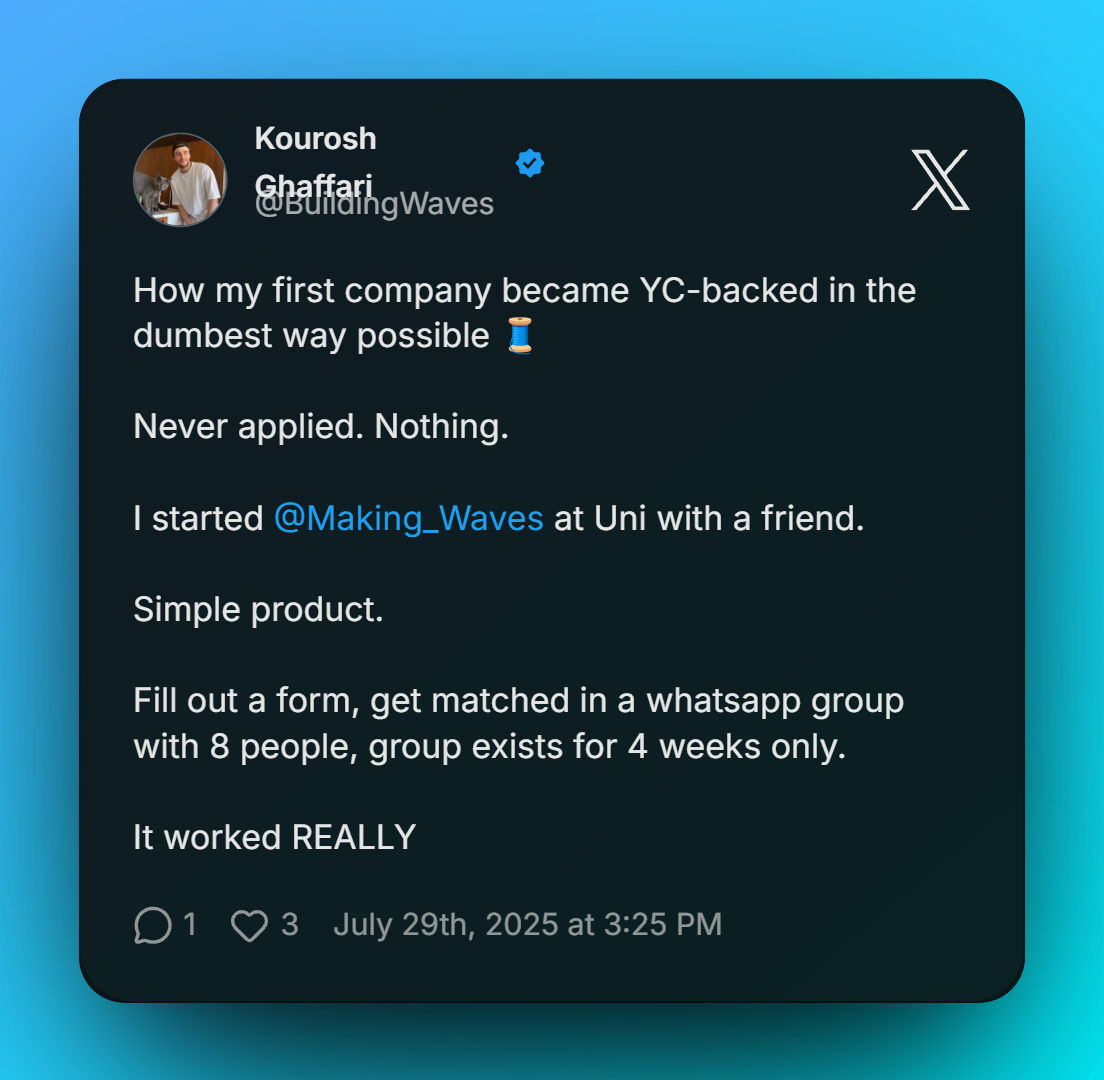 Kourosh is not a computer science graduate. He grew up in Tehran, Iran, and moved to London at age 18 to study business. Like many college students, he did not know what career he wanted, so he started playing around with online startups.
At first, he could not write a single line of code. He used visual "no-code" tools like Webflow and Bubble to stitch ideas together.
His first real software product was a community analytics tool called MeetWaves. He grew it to $5,000 a month in recurring revenue. That sounds like a huge win, but the business soon hit a wall and stopped growing.
Looking back, Kourosh knows the exact mistake he made:
"The first app that I properly built was a community analytics app called MeetWaves and that one grew to 5K MRR, but it never really took off because I just didn't do marketing."
MeetWaves taught him a lesson he never forgot: Building the software is the easy part. Getting people to find it is the real game.
That early project helped him land a 9-to-5 job as a Product Manager in London (and later a Senior Product Manager role at Tiiny Host). During the COVID-19 lockdowns, he bought a physical programming book and taught himself the basics of coding. Still, he did not feel good enough to code a full app from scratch—until AI coding tools arrived.
3. The Spark: Two Weeks in a Hospital Bed
Great products rarely start with a fancy spreadsheet. They start when you watch someone you love struggle with a real problem.
In late 2024, Kourosh's father flew in to visit him in London. Right in the middle of the trip, Kourosh got sick and ended up stuck in a hospital bed for two weeks.
His dad is a serious workaholic. Every single day, he sat beside Kourosh's hospital bed answering work emails on his laptop.
There was just one problem. His dad types with one finger.
"My dad was sitting next to me all day every day just typing on his computer like click, click, click—drove me insane. I swear to God, to write an email he took two to three business days."
His dad had tried old voice-typing tools before, but they made too many spelling mistakes. Around the same time, Kourosh was using the voice microphone inside the ChatGPT mobile app (powered by OpenAI's Whisper). It understood almost every word with near-perfect accuracy.
Lying in that hospital bed, Kourosh asked one simple question: How can I give my dad this exact voice typing inside every app on his computer, so he never has to copy and paste?
The 2-Week "Copy, Paste, and Pray" MVP
Kourosh decided to build the simplest version possible first: a Google Chrome extension.
He did not hire a developer. Instead, he opened ChatGPT, asked it to write the code for a Chrome extension that records voice and turns it into text, pasted that code into his code editor, and "prayed to God that it would work."
In just two weeks, Voicy was live on the Chrome Web Store. It put a small microphone button inside any text box on the web.
He only built it as a gift for his dad. He did zero marketing. Then something surprising happened: strangers started finding and downloading the extension every day on their own.
When people use your ugly first version without being asked, you have a real business on your hands.
4. The Big Insight: Sell "Painkillers," Not "Vitamins"
If you only remember one lesson from Kourosh's story, make it this one. It explains how a solo founder beat competitors with millions of dollars in funding.
Because Kourosh worked as a Product Manager during the day, he knew he needed to talk to his early users. He hopped on video calls with anyone willing to chat.
Very quickly, he saw that his users split into two completely different groups:
-
The "Vitamin" Buyers (60% to 70% of calls): Fast typists, programmers, and tech workers. They already typed 60+ words per minute. They used Voicy to work a little bit faster. They complained about tiny bugs, demanded complex features, and switched to competitors the moment a shinier app launched.
-
The "Painkiller" Buyers (20% to 30% of calls): Older adults (seniors) and people living with physical pain or disabilities—like arthritis, carpal tunnel, broken wrists, stroke recovery, or dyslexia.
When Kourosh listened to the second group, a lightbulb went off:
"Those guys loved the product. They didn't care about any improvements. They were like, 'This MVP I could live with forever.' ... Dictation tools to you and me are vitamins—they make us a little bit better. But to the people that I'm serving, it's a painkiller. Like, they need that product to work."
Big Silicon Valley startups did not care about 70-year-old grandparents or people with arthritis. That market did not look "cool" to venture capital investors.
So Kourosh stopped chasing tech workers and rebuilt Voicy's entire value proposition around the people who needed him most:
-
Tap-to-Talk (No Finger Pain): Many voice apps force you to hold down two keys the whole time you speak. If you have arthritis or one injured hand, that hurts. Voicy lets you tap one key (or a mouse button) once to talk, and tap again to stop.
-
A Trust-Based 20% Disability Discount: Voicy gives 20% off forever to anyone with a disability. You do not have to upload medical papers. You just email Kourosh and ask for it. Roughly 1 in 5 paying customers uses this discount.
-
Real Human Support: When an older user gets stuck setting up their microphone, they do not talk to an AI chatbot. Kourosh or a real person on his small team replies directly—often recording a personal video showing which button to click.
-
Windows First, Not Mac First: Most startup founders only build for Apple Macs. Kourosh built his Windows desktop app three months before his Mac app because everyday office workers and seniors use Windows PCs. Today, roughly 90% of his desktop users are on Windows.
-
Total Privacy & Offline Mode: Voicy does not save your voice or text. In October 2026 (Version 3.0), he added an Offline Mode so the AI runs directly on the user's computer without needing the internet.
5. How One Person Built 6 Apps (The Tech Stack)
Once the Chrome extension took off, users wanted Voicy inside desktop software like Microsoft Word, Outlook, and Slack—not just inside a web browser.
After discovering the AI code editor Cursor, Kourosh says his coding speed jumped 10x. Using AI coding assistants, he rolled out Voicy across six platforms by himself:
-
Chrome Extension (~2 weeks): Built with ChatGPT 3.5/4. Validated the idea for free.
-
Windows App (~3 months): Built with Electron and Cursor to serve the massive Windows market.
-
Mac App (~1 month): Reused most of the Windows Electron and React code.
-
Linux App (~2 weeks): Almost no competitors support Linux, giving Voicy an easy monopoly on Linux users.
-
iPhone Keyboard App (Shipped April 2026): Lets users dictate inside WhatsApp, iMessage, and Apple Mail.
-
Android App ("One-shotted"): Generated using Claude Opus models.
Monthly Software Costs (Lean & Profitable)
Kourosh runs the entire business on a tiny budget so he can keep most of what he earns:
-
Speech-to-Text AI: OpenAI's Whisper V3 model hosted on Groq (super fast, encrypted, zero data saved).
-
AI Punctuation & Rewriting: OpenAI GPT OSS and Qwen 3.8 27B models.
-
Website: Framer (~$200/month—his biggest fixed software bill outside of AI usage).
-
Backend Servers: IONOS VPS (~$40/month).
-
Analytics, Email & Payments: PostHog (free tier), Loops for email, Tella for video tutorials, and Stripe for payments.
6. The Growth Engine: How Voicy Gets 25,000+ Free Clicks a Month
Kourosh believes one big truth about business:
"Within a crowded market... it's not the best product that wins. It's the product that your customer sees first."
Instead of spending money on ads, he built four free traffic engines that stack on top of each other.
Step 1: The Chrome Web Store Funnel (First 100 Users)
When Kourosh launched his Chrome extension, he asked five friends to leave honest reviews on day one. That small push helped Voicy rank inside the Chrome Web Store search bar.
Even today, the extension gets 3,000 impressions, 150 page views, and 50 new downloads every single day for free. Better yet, Google gives every Chrome extension a powerful link (Domain Rating 100) that boosts his main website in Google search results.
Step 2: Daily Reddit Posts (Users 100 to 300)
To get his next 200 users, Kourosh posted helpful stories and answers on Reddit every single day across five or six communities until moderators eventually blocked him. It was manual work, but it brought in early buyers and filled his calendar with user feedback calls.
Step 3: Problem-First SEO in 5 Languages (25,000+ Clicks/Month)
Roughly 90% of Voicy's growth comes from SEO (Google search and AI search tools like ChatGPT).
Instead of writing boring company news, Kourosh created 200+ helpful blog posts and 30+ specific landing pages answering the exact questions his buyers type into Google:
-
"How to use voice typing in Microsoft Word"
-
"Speech to text for Carpal Tunnel Syndrome"
-
"Best Dragon NaturallySpeaking alternative"
-
"How to dictate emails in Gmail"
He also translated his website into German, French, Spanish, and Japanese. Because most startup founders only write in English, Voicy easily grabbed the #1 spot on Google in non-English countries.
To speed this up, Kourosh spent a year coding an automated SEO tool that writes one new helpful article and fixes one older page every day using real Google data. He later turned that internal tool into his second business, RomeoSEO (romeoseo.com), which now makes nearly $1,000/month on its own.
Step 4: The "AI for Seniors" YouTube Channel
Once Kourosh knew older adults loved his app, he started a YouTube series called "AI for Seniors."
In these videos, he speaks slowly and kindly. He explains tools like ChatGPT in plain English—comparing AI to "superpowered phone autocomplete"—and mentions Voicy for just 20 seconds as the tool he built for his dad.
His first lesson passed 490,000+ views, and his YouTube channel jumped from 1,000 to 12,000 subscribers in a single month.
7. Pricing, Revenue & The $1,400/Month "Monster Prompt" Fix
If you look at Kourosh's public numbers, you will see two different figures: $12,400 MRR and $16,000 to $20,000 in total monthly revenue.
Why is his total cash so much higher than his monthly subscription revenue? Because of Lifetime Deals.
-
Free Trial: 30 minutes of free speaking time (no credit card needed).
-
Pro Plan: $8.49/month (or $82/year).
-
Lifetime Plan: $260 one-time payment forever.
Older buyers hate monthly bills. Plus, they often compare Voicy to old-school dictation software like Dragon NaturallySpeaking, which costs $300 to $600+. To them, paying $260 once feels like a bargain—and it hands Kourosh an extra $5,000 to $8,000 in upfront cash every single month.
The October 2026 Profit Hack
On October 29, 2026, Kourosh shared a post on X that every software builder should study:
"@VoicyApp's MRR is up only ~$300 in October. BUT profit is up ~$1400. Why? We cut our AI spending in half by updating our prompts. We kept adding to our prompts until they turned into monsters. 2 weeks ago we cut it down AND improved performance. When you can't grow revenue, reduce costs instead ;)"
Here is what happened behind the scenes: Every time a user found a small formatting bug over the past year, Kourosh added another sentence of instructions to his AI system prompt. Over time, that prompt grew into a giant "monster."
Because AI companies charge for every single word in your prompt every time a user speaks, that long prompt was quietly burning $1,400 a month in wasted fees—and confusing the AI. By deleting the extra fluff and keeping his instructions short, he cut his AI bill in half, made the app faster, and put $1,400/month ($16,800/year) of pure profit straight into his bank account.
8. Steal This Playbook: 6 Actionable Lessons for Builders
You do not need a million-dollar idea or a computer science degree to build a life-changing software business. Here is the exact playbook you can copy from Voicy today:
-
Solve a Problem You Can See With Your Own Eyes: Do not guess what strangers want. Watch your parents, coworkers, or friends work on their computers. Where do they get frustrated or slow down? Build the fix for one real person first.
-
Find the Buyer Who Needs a "Painkiller": Launch a simple version fast, then talk to the people who download it. Ignore the picky users who just want a "vitamin." Double down on the group that cannot live without your tool.
-
Use a Chrome Extension as a Free Traffic Magnet: Even if your main product is a desktop or mobile app, build a simple Chrome extension. It gives you free daily downloads from the Chrome Web Store and a massive SEO boost from Google.
-
Write "How-To" Pages, Not Feature Pages: Nobody wakes up searching Google for your brand name. They search "how to do [task] in [app they already use]." Create a dedicated page for every single app and language your tool works with.
-
Pair Low Monthly Prices With a High-Ticket Lifetime Deal: Give subscription-haters a one-time payment option priced at roughly $25\times$ to $30\times$ your monthly price. It brings in thousands of dollars in immediate cash without taking money from investors.
-
Turn Off Your Brain and Ship Volume: When asked what advice he would give his younger self, Kourosh gave a rule straight out of Atomic Habits:
"Turn off your brain. It's really not that serious. And just do things. If you think you can grow your app by writing a blog post, write 10. If you think you can grow it by doing a YouTube video, do five videos... Quantity will get you to quality, and it'll get you way more learnings way quicker."
Sources & Fact-Check Notes
-
Primary Sources: Voicy Official Website (
usevoicy.com), About & Disability Discount Pages, Kourosh Ghaffari's X Profile (@BuildingWaves), X Profit Post (status/2115793523853164712, Oct 29, 2026), Starter Story Interview (Oct 2026), and the UseVoicy with Kourosh YouTube Channel (AI for Seniors). -
Revenue Verification: MRR ($11.6K–$12.4K) and all-time Stripe revenue ($164K–$192K+) are tracked via public Stripe-connected directories (TrustMRR / IndieMakerList) and founder dashboard screenshots shared publicly up to November 2026.
-
Name Note: This case study covers
usevoicy.com(founded by Kourosh Ghaffari in London in 2024), not to be confused with the Japanese audio platform Voicy Inc. or Voicy.AI.