I Got Laid Off With $500 Then Built a $72K/Year Marketplace That Sold $500K+ in Startups
 ## Hello! Who are you and what business did you start?
Hey, makers! I'm Ilya Novohatskyi, a software engineer turned founder from Ukraine. I am the creator of Microns.io, a marketplace where entrepreneurs, indie hackers, and investors can discover, buy, and sell profitable micro-startups.
We focus entirely on the "micro" segment of the market side projects, micro-SaaS businesses, Chrome extensions, Shopify apps, WP plugins, and newsletters. These are typically bootstrapped projects with asking prices ranging from $300 to $100,000, and sometimes up to $1M.
By the end of 2025, completely bootstrapped, we had facilitated a cumulative GMV (Gross Merchandise Value) exceeding $500,000 across more than 100 successful deals. Today, Microns is a vibrant community with over 10,000 qualified buyers and builders subscribed to our updates.
Financially, our growth has been a testament to the power of compounding. I went from making just $3K in 2021 to generating $71,284 in revenue in 2025. We evolved from a simple newsletter into a full-fledged platform where founders can exit their hard work, and buyers can acquire validated, revenue-generating assets without starting from zero.
Ilya Novohatskyi
Founder · Microns.io
 Ukraine
This story is compiled from public sources and presented in an interview format for a better reading experience.
What's your backstory and how did you come up with the idea?
My entrepreneurial journey started out of pure necessity. I studied Software Engineering at KPI in Kyiv. During my third year, I joined a Ukrainian IT company working on web platforms and mobile apps for US and European clients. But when the COVID-19 pandemic hit, the project I was on was cut, and I was suddenly laid off.
With only about $500 in savings, survival became my strongest motivator. I moved in with my parents (along with my girlfriend) to minimize expenses and keep our burn rate as close to zero as possible. Instead of finding another 9-to-5, I teamed up with a former sales colleague and co-founded Quanti Coders, a software development agency positioned as “10x developers on demand.”
It took us about six months of grinding on Upwork to get real traction, but we eventually grew to a team of seven and hit roughly $15K/month in revenue. I was the CTO, and we reinvested every dollar we made.
While running the agency, I spent my nights on Indie Hackers and Twitter. I noticed a recurring theme: indie founders were desperately trying to sell their small, bootstrapped, profitable side projects just by tweeting about them. I looked at existing M&A platforms like MicroAcquire (now Acquire.com) and realized they had moved upmarket to much larger deals, leaving a massive gap for truly micro acquisitions.
I saw the demand for a dedicated, trustworthy space for small exits. I initially pitched the idea to my agency co-founder, but he wasn't enthusiastic. We ended up splitting, and I decided to proceed with Microns solo, building it on nights and weekends.
Take us through the process of building the first version of Microns.
 One of the most important aspects of Microns is that the early MVP was built entirely using no-code tools. This kept overhead incredibly low and allowed me to validate the idea fast.
When I started, I kept the stack lean:
-
Webflow: For the UI/UX and landing pages.
-
Revue: For our weekly newsletter featuring new startups for sale.
-
Zapier: The glue for automations and routing.
As the platform gained traction, the architecture had to mature to handle verified metrics, user accounts, and secure transactions. I eventually migrated to a more robust, low-code stack:
-
Wized: For front-end logic and API connections.
-
Xano: For a powerful backend and database.
-
Google Cloud: For secure storage.
-
Google Apps Script: To automate contracts.
Manual Vetting is Our Feature:
From day one, the core value of Microns hasn't just been the tech; it has been the trust. We manually vet every single listing. We verify revenue claims, check traffic, ensure there's no malware, and validate authentic websites. In a space where scams and inflated metrics are risks, this manual work was our biggest differentiator.
Describe the process of launching the business and getting your first customers.
Getting traction for a two-sided marketplace means solving the "chicken and egg" problem.
To get early supply, we offered free listings for sellers. To get demand, I recruited newsletter subscribers using pure cold email.
Our first major inflection point was our Product Hunt launch, which went incredibly well (we secured 3rd place, drove 3,000+ visitors, and gained over 500 new subscribers in one day).
From there, my growth engine was built entirely on Community and Transparency. I practically lived on Indie Hackers and Twitter, building in public. I shared my exact journey progress, failures, success stories, and educational content on M&A and valuations. I did AMAs with titles like "I sold $180K worth in 2023" which generated massive trust and inbound interest.
How does the business model work, and what are your revenue numbers?
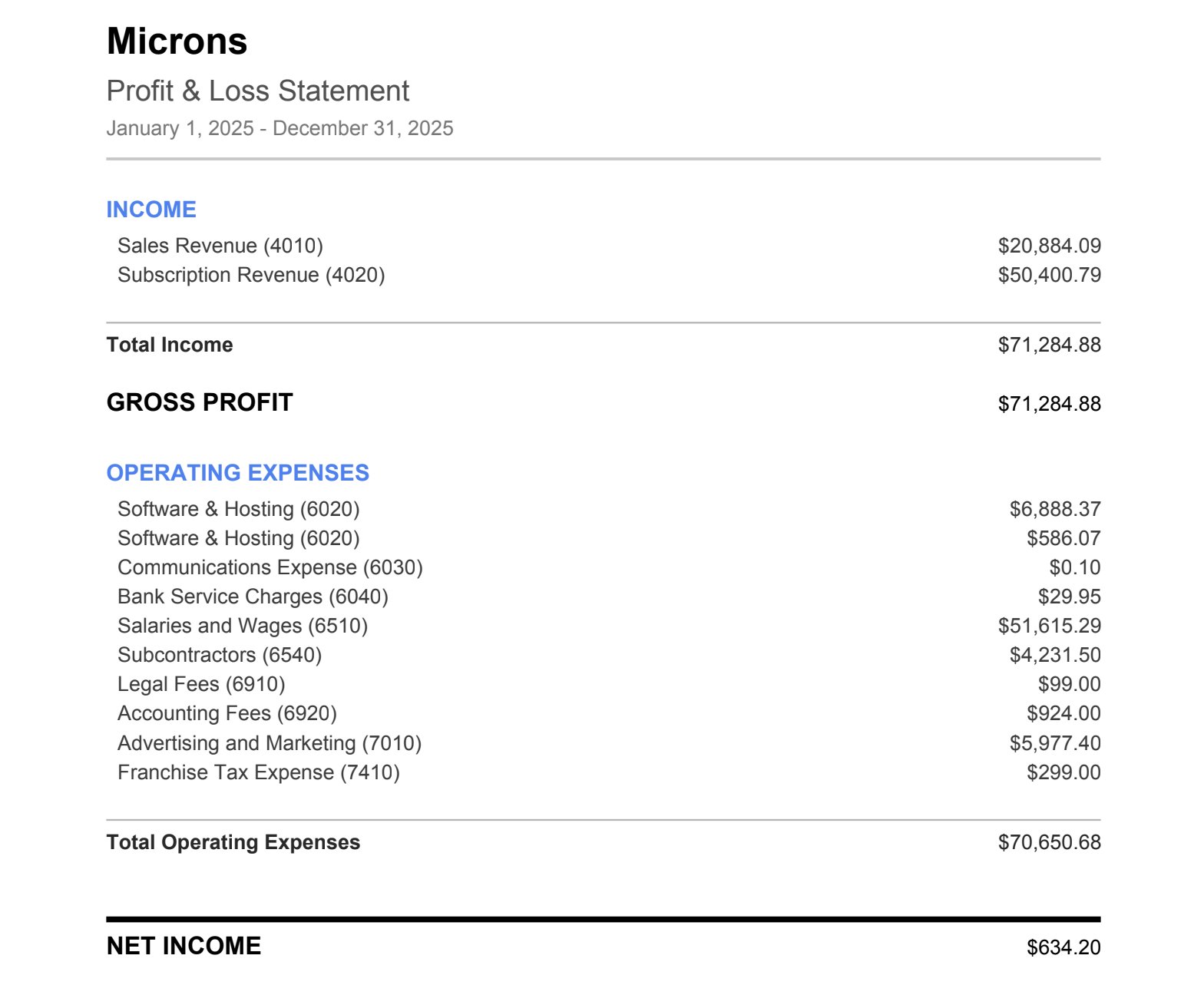 Traction in bootstrapped products is slow, but it compounds beautifully if you survive long enough. I have shared my P&L publicly from the beginning. My revenue journey with Microns looks like this:
-
2021: $3,000
-
2022: ~$28,000
-
2023: ~$40,000 (Facilitated ~$180K in GMV across ~40 startups)
-
2024: ~$58,000
-
2025: $71,284 (Facilitated $200K+ in GMV)
The Evolution of the Model:
Initially, Microns was a zero-commission model. We monetized exclusively through the demand side: buyers paid a $299/year subscription (or a monthly equivalent) to access premium deal flow, verified financials, and direct seller contacts.
However, we noticed annual subscriptions started to stagnate as users preferred monthly options, and we saw friction in how deals actually closed.
To solve this, in March 2025, we launched the "Offers" feature. This allowed buyers to make direct offers and streamlined the entire asset transfer process directly on the platform. This completely transformed our business. We began charging seller success fees (ranging from 6% to 10% depending on deal size), and our transfer service revenue exploded growing from $5,000 in 2024 to over $20,000 in 2025.
For example, in one single month recently, we facilitated 9 sales worth $45,000.
What were the biggest challenges you faced?
Building During a War
Without a doubt, the hardest challenge has been the war in Ukraine. We faced constant electricity blackouts, missile alerts, and having to work from bomb shelters. The team was disrupted, and my personal life was upended. I had to rebuild my team with remote Ukrainian talent while dealing with rising living costs. What saved me was the mindset I adopted back when I had $500 to my name: keep personal burn rates incredibly low, stay independent, and never give up.
Marketplace Dynamics
Balancing supply and demand is a constant battle. A hard lesson I learned is that pre-revenue projects are incredibly difficult to sell. Buyers want validated, revenue-generating assets. We had to strictly focus on sourcing profitable or near-profitable projects to keep the marketplace healthy.
What are the biggest lessons you've learned on your journey?
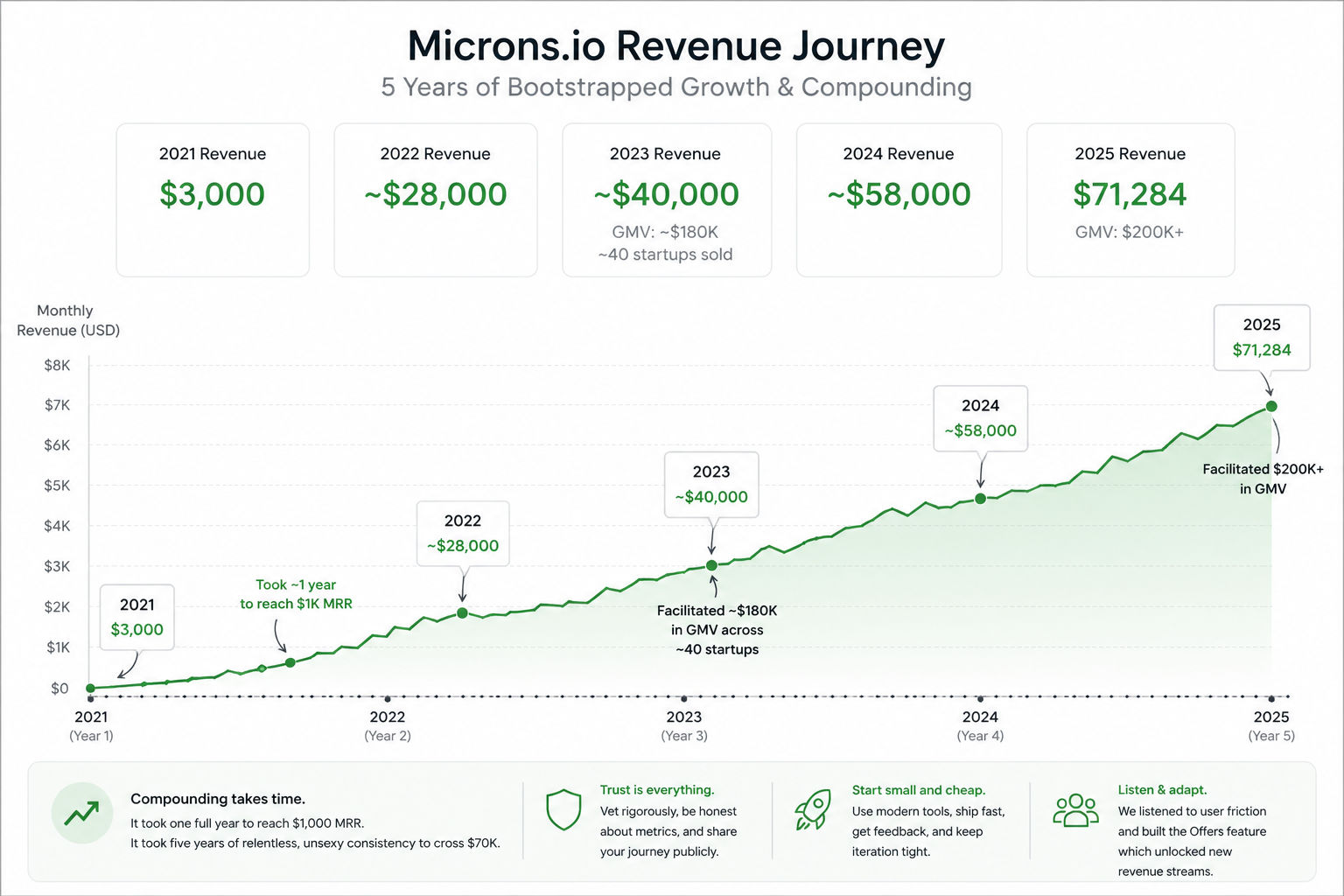 Compounding takes time. It took one full year to reach $1,000 MRR. Bootstrapping is slow. Look at my revenue curve: it took five years of relentless, unsexy consistency to cross $70k.
-
Trust is everything. If you are building a marketplace, you aren't selling a SaaS tool you are selling trust. Vet rigorously, be honest about metrics, and share your own journey publicly.
-
Start small and cheap. Today, you can build incredible things with AI coding tools (like Claude), free tiers on Vercel or Supabase, and Stripe. Build the MVP, share it on Twitter, and listen to the feedback.
-
Listen to your users and adapt your revenue streams. The agency funded Microns early on. Later, when buyer subscriptions leveled off, we listened to user friction and built the Offers feature, which unlocked massive transfer and success fee revenue.
Any final advice for founders looking to buy or sell?
If you are selling: Prepare clean metrics. Have your P&L ready, record a demo video of the product, and write a compelling story about its growth potential. Even modest traction commands better multiples, because buyers will pay a premium for a growing asset.
If you are buying: Don't take unnecessary risks on unverified opportunities on social media. Use vetted platforms where financials are verified.
If you are building your own platform: Find a painful problem in a community you belong to. Ship fast with low-code or AI tools, document everything publicly, and reinvest your early revenue. Real builders don't wait for permission.