He Sold a SaaS in 30 Days for $2.5K (Here’s the $800K Micro-SaaS System Behind It)
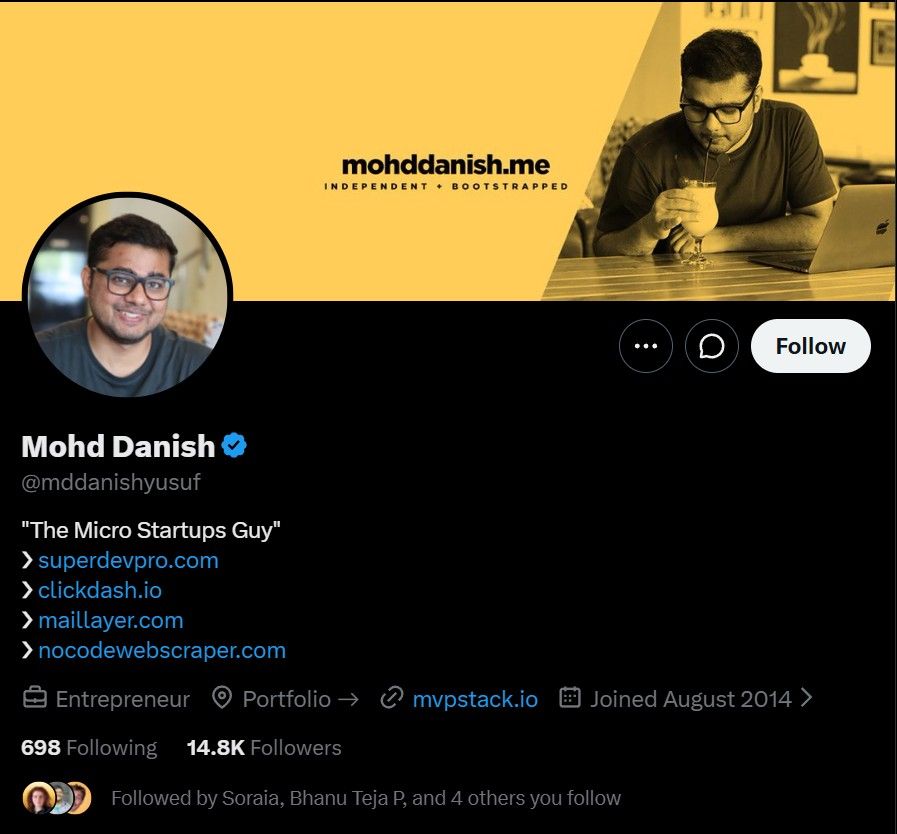
Mohd Danish Yusuf
Founder · CrawlAPI.dev
This story is compiled from public sources and presented in an interview format for a better reading experience.
Hello! Who are you and what business did you start?
Meet Mohd Danish Yusuf, an indie hacker, solo founder, and the epitome of the "Company of One" philosophy. Known on X as "The Micro Startups Guy," Danish is a serial builder who specializes in identifying developer pain points and shipping incredibly fast.
Over an 8-year span, he went from making $200 a month as an intern to pulling in over $18,000 a month in profit, generating roughly $800k in total revenue, and completing 7+ micro-acquisitions.
His flagship success was NoCodeAPI—a tool connecting third-party APIs with no-code platforms without backend infrastructure—which he scaled to ~$5,000 MRR and sold for a 6-figure sum.
But Danish operates on volume and execution velocity. He has built over 40 products (failing at roughly 60% of them). This case study breaks down his journey, his framework, and his latest micro-flip: building and selling CrawlAPI.dev in just one month.
The Backstory: Escaping the 9-to-5
In 2017, at the age of 25, Danish was in his final year of his Master’s degree. He landed an internship as an Angular.js web developer for a US-based company, making about $200 a month. By 2018, he had secured a full-time job, bumping his income to around $542/month, and supplemented it by freelancing at night.
But the traditional corporate ladder didn’t sit right with him.
After reading the first 20 pages of the book "Company of One" by Paul Jarvis, Danish experienced a paradigm shift. He found the motivation he needed, quit his job just 8 months in, and moved to South India to build a business entirely by himself.
He didn't have funding. He didn't have a massive audience. What he did have was a ruthless bias for action.
The First Big Win: Validating the Model
Danish’s journey to a 6-figure exit didn't start with his biggest product. It started with a free resource.
In January 2019, he took an open-source GitHub repository and turned it into a project called Public APIs. He launched it on Product Hunt, and it skyrocketed to the #1 Product of the Day.
The Growth of Public APIs:
-
Within 4-5 months, the site was generating 50,000+ page views.
-
Over 30% of the traffic came organically from Google Search.
-
Crucial detail: He wasn't monetizing it yet. He was just continuously adding new APIs to the directory manually.
After 9 months of traveling as a digital nomad across India, Singapore, and Indonesia, an API company reached out and offered to buy the project. Danish sold it for $23,000.
This validation proved that the API space was incredibly lucrative, and developers were willing to pay for tools that saved them time.
Building and Launching the Flagship SaaS: NoCodeAPI
Armed with a $23k safety net, Danish completely stopped taking freelance client work in late 2019. He focused entirely on exploring API software ideas.
He noticed a massive gap in the market: No-code tools were exploding in popularity, but integrating them with external APIs was still a massive headache for non-developers.
In November 2019, he began coding NoCodeAPI.
The Launch Strategy:
Danish launched NoCodeAPI in January 2020. His go-to-market strategy was deeply rooted in his previous success:
-
Product Hunt Launch: Leveraging the indie hacker community.
-
Freemium Model: Allowing users to test the API endpoints for free, building trust before asking for a credit card.
-
Building in Public: Sharing his MRR (Monthly Recurring Revenue), traffic, and feature updates on Twitter (@mddanishyusuf).
By the end of 2020, NoCodeAPI had grown to $2,000 MRR.
(Side note: During this same year, Danish built a small Twitter API website in just 11 hours and sold it for $5,000 within a month. Shipping fast was his superpower).
Growth, Strategy, and Hitting $5k MRR
Danish’s approach to scaling NoCodeAPI was entirely bootstrapped. He didn't burn cash on paid ads. Instead, he focused on:
-
SEO & Content: Writing documentation and use-cases for every single API integration he added.
-
Listening to Users: He let the community dictate the roadmap. If enough users requested an Airtable integration, he built it.
-
The "Save Time = Make Money" Formula: Danish priced NoCodeAPI based on the hours of backend development it saved users.
By 2021, NoCodeAPI hit $3,500 MRR. In 2022, the product crossed the $5,000 MRR mark.
The Exit: Selling for 6-Figures
With a highly profitable SaaS, a massive user base, and a stable MRR of $5,000, NoCodeAPI became a prime acquisition target.
In 2022, Danish sold NoCodeAPI for a 6-figure sum (estimated $180k–$200k).
Why sell? As an indie hacker, the goal isn't always to build a unicorn. Sometimes, the goal is financial detachment and freeing up mental bandwidth to build the next fun project. His total earnings for 2022, combining his MRR and the acquisition, hit $216,433.
The Next Chapter: Micro-Acquisitions (The IconBuddy Case Study)
After his 6-figure exit, Danish pivoted into Micro-Acquisitions—buying neglected projects with zero revenue but decent traffic.
In mid-2023, he bought a dead project called IconBuddy.app for $4,000.
-
The Polish: He added authentication and iterated the UI to make finding icons flawless.
-
The Distribution: He built a Figma Plugin, which trended for 20 days and got 4,000+ installs in a month.
-
The Monetization: He offered a Lifetime Deal (LTD). He started at $49, then systematically increased the price to $149 while offering strategic "discounts."
In 9 months, Danish turned a $4,000 dead project into a machine that generated $15,497 in pure profit, scaling it to a $6k/month business.
The 30-Day Micro-Flip: Building and Selling CrawlAPI.dev
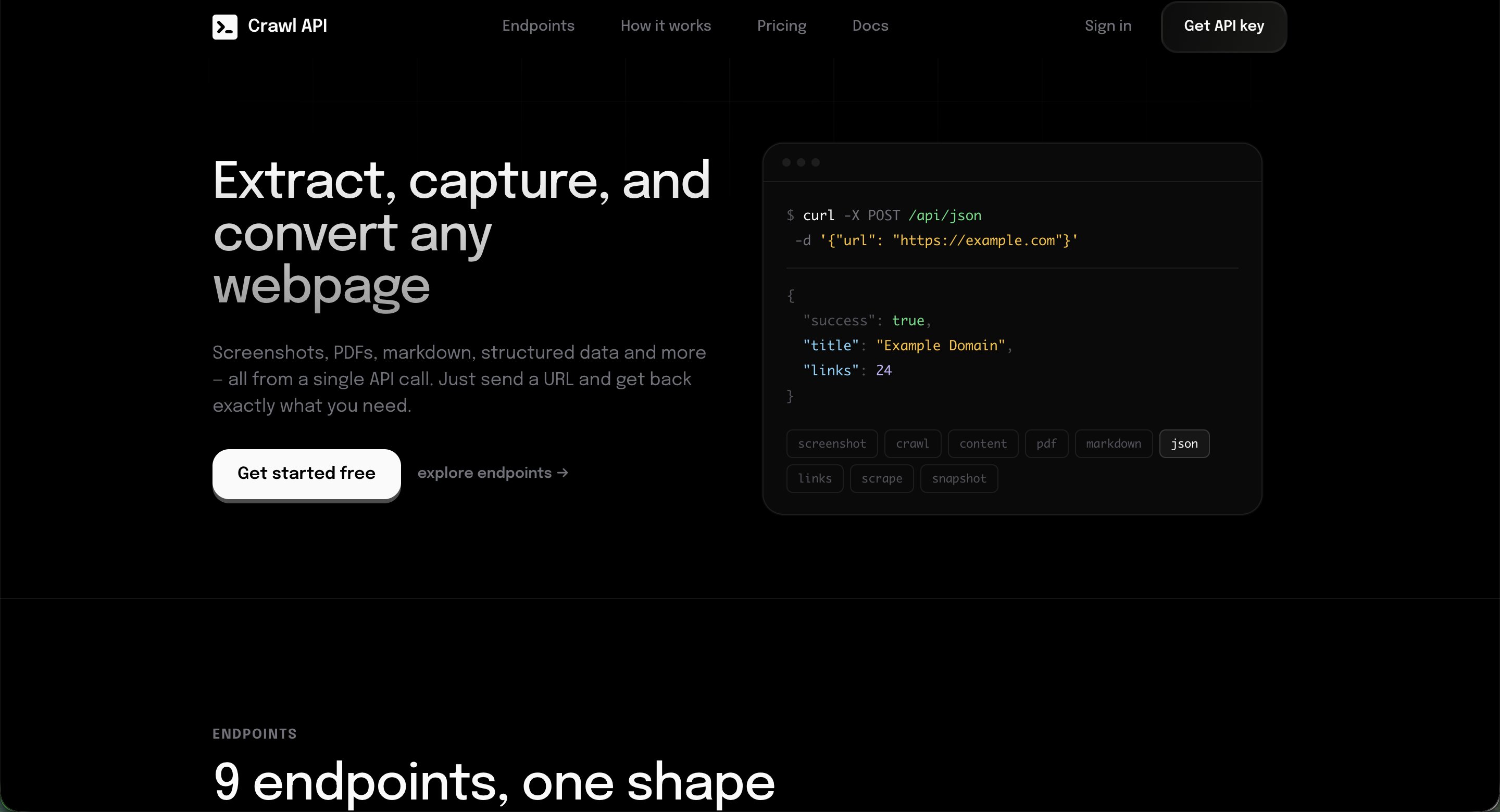 Danish doesn't just buy; he still builds from scratch. His recent project, CrawlAPI.dev, perfectly encapsulates his high-speed, pragmatic playbook.
The Product:
Launched in mid-March 2026, CrawlAPI is a headless browser REST API for extracting structured data, screenshots, and PDFs from any webpage. Headless browsing is a massive pain for developers (managing Puppeteer/Playwright clusters, anti-bot measures, server costs).
Danish solved this with a brilliant UX decision: One consistent POST request format across 9 different endpoints (e.g., /api/crawl, /api/screenshot, /api/pdf).
Traction & Revenue Reality Check:
He launched organically via X. Within roughly one month, the platform acquired 31 users.
However, the revenue sat at $0 MRR. He offered 30 free credits on sign-up, and while developers were actively testing the tool, converting them to paid plans ($9 to $99/mo) required heavy content marketing and SEO.
The Exit:
Danish is a realist. He was simultaneously running other tools (like ClickDash and SuperDevPro) and admitted he simply lacked the bandwidth to market CrawlAPI properly.
On April 28, 2026—just over a month after launch—he posted a "For Sale" thread on X. He listed the project for $2,500 via a simple Stripe payment link. It sold the same day to another developer (@DevMuzzammil).
Some debated if $2,500 was too high for a $0 MRR product. But the buyer wasn't paying for revenue; they were paying to bypass weeks of backend development. They acquired a clean domain, a production-ready infrastructure, and 31 warm leads for the price of a decent laptop.
5 Key Takeaways for Builders
-
Volume Over Perfection: Danish has built over 40 products and failed at 60% of them. But his wins (NoCodeAPI, Public APIs, Iconbuddy) easily pay for the failures. The micro-SaaS game is about compounding small wins.
-
Bandwidth is the Real Constraint: Many solo founders underestimate the marketing load. Danish selling CrawlAPI for $2,500 instead of letting it die on the vine is a masterclass in freeing up time and capital.
-
Transparent Selling Works: You don't need a broker for a micro-exit. A public post with exact numbers (users, MRR, age) builds trust. Selling a working codebase and domain via a Stripe link lowers friction immensely.
-
Solve Painful, Repeatable Problems: Danish didn't reinvent the wheel. Connecting APIs (NoCodeAPI) and managing headless browsers (CrawlAPI) are universally tedious dev ops tasks. Save developers time = Make money.
-
Pricing is a Marketing Game: Don't force MRR if it doesn't fit. With IconBuddy, Danish proved that systematically increasing the price while offering "discounts" on Lifetime Deals drives urgency. With CrawlAPI, he used a transparent, per-call credit model ($9 for 1,000 calls).
Follow Mohd Danish Yusuf’s journey on Twitter @mddanishyusuf as he continues to build tools under MVP Stack and scale his solo portfolio.