He Failed Twice… Then Built a €10k ARR SaaS in 90 Days Without Ads
Hello! Who are you and what business did you start?
Hey! I’m Eric Djavid, a solo full-stack developer, creator, and full-time digital nomad. I build products while island-hopping across places like Thailand and Bali.
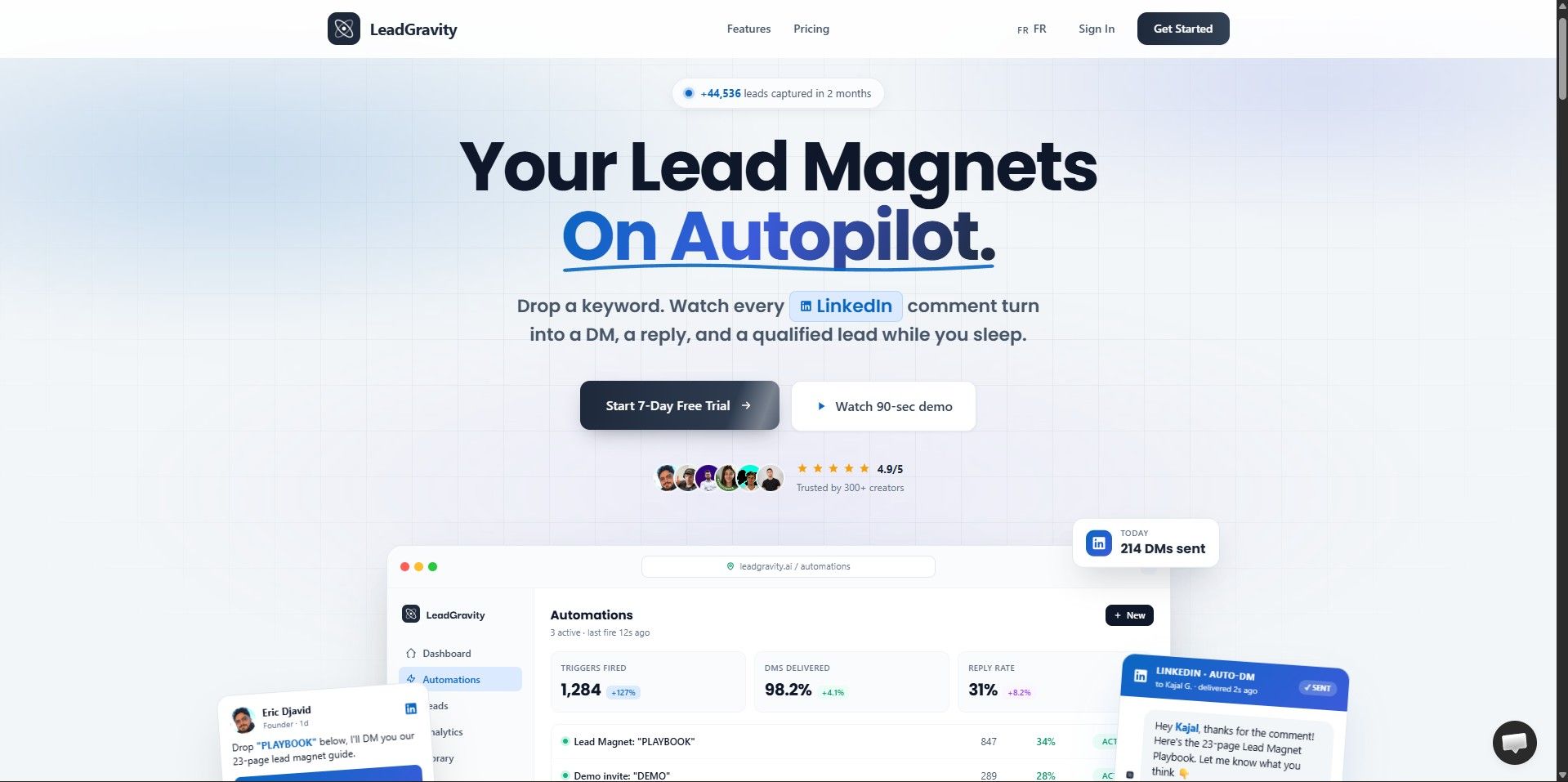
My flagship product right now is LeadGravity.ai—an all-in-one LinkedIn automation tool designed to turn comments on your posts into qualified leads with zero manual work. The concept is simple but incredibly powerful for B2B creators: you tell your audience to drop a keyword (like "PLAYBOOK") in the comments of your post. LeadGravity automatically detects it, sends a highly personalized DM with your lead magnet, captures the lead's enriched data (job title, company, profile), and pushes it straight to your CRM.
The kicker? It uses zero Chrome extensions, requires no LinkedIn API keys, and carries no risk of bans because it operates through your native LinkedIn session.
I launched it just 3 months ago, and it has already crossed €10k ARR, powering over 300 creators and capturing tens of thousands of leads. Alongside LeadGravity, I run a portfolio of micro-SaaS apps, including English With Lewis (currently doing $504 MRR), bringing my total indie portfolio to around $1,700+ MRR.
What's your backstory and how did you come up with the idea?
My background is a mix of the 42 coding school and HEC connections in Paris. Before going all-in on indie hacking, I co-founded and ran Reskue (a tech/services agency) from 2022 to 2024 as CEO and full-stack dev.
When I transitioned to building my own SaaS products, it wasn't an instant success. I openly share my early failures on X:
-
My first SaaS made $80 in 2 months.
-
My second SaaS made $400 in 2 weeks.
Things only started to click when I adopted the "Creator × Builder" model: create content that attracts the exact audience who needs what you build, then dogfood your own tool to sell it.
The specific pain point that sparked LeadGravity was brutally personal. Like every B2B founder, I was leveraging lead magnets on LinkedIn ("Drop PLAYBOOK below and I’ll DM you the guide"). It worked too well. I was spending hours manually replying to hundreds of comments, sending DMs, enriching leads, and chasing follow-ups. It killed my time. I needed automation that felt human, stayed safe, and actually closed deals. Since I couldn't find a safe solution, I built it.
Take us through the process of designing and building the first version.
I didn’t run surveys or wait for perfect Product-Market Fit. My rule for building is simple:
"You need to: 1. Build something you’d use. 2. Put it on Twitter. 3. See who buys it. 4. Build for those people. The market finds you when your product is good."
I spent over a year iterating on LeadGravity privately, refining the system on my own 30k-follower LinkedIn account before ever selling a single copy.
The Core Mechanics:
-
Keyword Triggers: Users can set multiple keywords, regex, and exclusions. When a commenter drops the word, the tool sends a personalized DM/reply using variables like
{{firstName}},{{headline}}, and{{company}}. It only sends during business hours with human-like random delays. -
Safety First: This was paramount. No password sharing, no risky extensions. I built in daily caps (e.g., max ~150 DMs, ~250 comments recommended). The account health dashboard shows "excellent" after 127+ days live because I built it around the real restrictions I hit on my own account.
-
All-in-one Stack: It includes an AI post generator, a post scheduler, a library of 400+ forkable lead-magnets (like a "Cold Outbound Playbook" with a proven 42% conversion rate), live analytics, and one-click CRM pushes to HubSpot, Notion, Airtable, CSV, etc.
The Tech & Workflow:
I'm a solo full-stack dev. I don't have a massive team. I rely heavily on Claude AI for dashboards, recurring tasks, and real-time artifacts. I recently built a live dashboard in 3 minutes with Claude while chatting about it publicly.
My daily routine as a nomad is relentless: 8 AM coffee + code, 2 PM ship, 9 PM tweet.
Describe the process of launching the business.
I beta-tested with about 10 users before launching. I did zero customer discovery calls beforehand. I just shipped it.
The launch was quiet but lethal. I posted on X, Product Hunt, and especially LinkedIn. But the secret sauce was dogfooding—I used LeadGravity to sell LeadGravity. It's the ultimate inSAASption loop.
I would post a lead magnet on my LinkedIn ("Drop 'PLAYBOOK' below, I'll DM you our 23-page guide") and let LeadGravity capture every commenter. Some campaigns hit 700k+ views in 7 days, capturing hundreds of leads automatically. My early users were the exact audience I targeted: SaaS founders, agency owners, and content creators with 1M+ followers who experienced my tool firsthand by commenting on my posts.
The first paying customer dropped €59 on Day 3 after launch.
Since launch, what has worked to attract and retain customers?
1. Zero Ads, 100% Organic & Product-Led Growth:
I have never spent a dime on paid ads. I build community among indie hackers and creators on X with short, transparent updates ("launched 2 months ago → €800 MRR", then "3 months → €10k ARR").
2. Mind-Blowing Metrics & Case Studies:
The product speaks for itself. In a recent snapshot, the traction looked like this:
-
44,536 total leads captured across users in ~2 months.
-
1,284 triggers fired in a single 7-day window.
-
98.2% DM delivery rate and a 31% reply rate.
-
Testimonials from SaaS founders at €30k MRR getting 150 qualified leads in month one, and agency owners saving 20+ hours a week.
3. Value-Based Pricing That Prints Money:
I use clear tiers with a 7-day free trial:
-
Starter (€29/mo): 10 automations, core features.
-
Pro (€45/mo - Most Popular): 100 automations, advanced analytics.
-
Pro Max (€91/mo): Unlimited everything.
Offering a yearly discount (-20%) makes the revenue sticky, and many users upgrade from Starter to Pro as their comment volume grows.
How are you doing today and what does the future look like?
Today, LeadGravity is at €10k ARR with over 500 total users and a 4.9/5 rating.
But I'll give you the real talk: being a traveling solo founder isn't just aesthetic sunsets. I've posted videos titled "5 Islands, 1 Dead Rat, $4,000" documenting the wild realities of this lifestyle. The "lonely grind" people see is just hyper-focus. I deal with runway pressure, feeling like my products are only at 2/10ths of their potential, and missing my girlfriend who is 10,000 km away.
But I keep shipping. My portfolio approach gives me stability. The goal now is scaling LeadGravity, adding Sales Navigator integrations, and opening up APIs for the Pro Max tier.
Through starting the business, have you learned anything particularly helpful or advantageous?
I recently wrote an Indie Hackers article called "Avoid Failure: 3 Don’ts and 3 Must-Dos for Startup Founders". Here are the core takeaways from my journey:
1. Build what you personally bleed for. I hated manual LinkedIn engagement, so I fixed it for myself first. If you don't feel the pain, you won't build the right cure.
2. Charge before you feel ready. My first sale on Day 3 proved the market existed. Don't wait 6 months to add a Stripe link.
3. Dogfood ruthlessly. Using LeadGravity to sell LeadGravity created the perfect marketing flywheel. If your product is a marketing or sales tool, it should be able to sell itself.
4. Safety + Simplicity Wins. In the automation space, people are terrified of bans. By explicitly building a system with no API keys and no Chrome extensions, I built immediate trust, leading to incredibly low churn.
What platform/tools do you use for your business?
-
AI & Development: Claude AI (My go-to for rapid dashboard building and complex coding tasks).
-
Social Platforms: LinkedIn (for B2B customer acquisition) and X/Twitter (for building in public).
-
Payments: Stripe
Advice for other entrepreneurs who want to get started or are just starting out?
Stop over-researching and start shipping. You don’t need VC funding, a big team, or perfect market research.
You need to ship something useful, market it where your audience already hangs out, and iterate in public. Transparent build-in-public updates with real metrics convert infinitely better than polished corporate sales pages.
Multiple micro-SaaS apps are often better than one big bet. Use a portfolio approach to give yourself runway while you wait for one product to 10x. If you're building in public and solving real problems, the market will find you—as long as you ship something people actually pay for.
Eric Djavid
Founder · LeadGravity
This story is compiled from public sources and presented in an interview format for a better reading experience.