Burnt Out to 6-Figure Exit: How I Built & Sold Fluar and Hit $1K MRR in 6 Days with Clicky

Hello! Who are you and what business did you start?
Hey! I’m Kamil Zowczak, an indie hacker, programmer, and AI builder originally from Poland. My bio simply reads: "you can just hack things • 2x exited founder." Over the past couple of years, my journey has been a wild ride from dealing with severe burnout as a project manager, moving to Bali to learn how to code, and eventually shipping products like a madman.
I am best known for a few major milestones in the indie hacking space:
-
CopyCopter: An AI-powered SaaS for viral, faceless short-form videos. It went viral on Chinese TikTok (Douyin), scaled 30x in under a year, and I sold it for 5-figures via Acquire.com.
-
Fluar: A spreadsheet-like tool for AI automations and data workflows. I bootstrapped it as a solo founder, hit $1K MRR, and recently sold it in an all-cash 6-figure deal.
-
Clicky: My latest project. An AI companion built with Farza (ex-buildspace) that lives next to your cursor on macOS. We hacked it together in 10 days, open-sourced the base, and hit $1K MRR in just 6 days.
Today, I’m building frontier AI desktop interfaces, operating out of hacker houses in San Francisco, Europe, and Bali. This is the story of how I turned relentless shipping into life-changing momentum.
What's your backstory and how did you come up with the idea?
To be completely raw, my journey started from a place of deep frustration. In early 2023, I was miserable. I was working as a project manager, totally overworked, highly stressed, dealing with imposter syndrome, and on antidepressants. I realized the traditional operational path was destroying me.
I needed a hard reset. So, I quit my job, took my savings, and moved to Bali. I gave myself a strict timeline to teach myself how to code and survive.
My very first taste of indie hacking success was a project called MrScraper. Operating under the pseudonym Kai, I built it strictly in public. It was a visual web scraper designed to make data extraction frictionless. It got great peer reviews for its UI, and I managed to grow it to about $300 Monthly Recurring Revenue (MRR) roughly $1,700 ARR. I hit a growth ceiling as a solo dev, so I listed it on Acquire.com and sold it. (Fun fact: The buyer completely rebuilt the backend with AI and scaled it to $1.7M ARR!).
That first micro-exit validated everything. But I still had to survive. I built and killed several SaaS products in 2023 (Flyfile, Finey, Yove) that never got traction.
Then came CopyCopter. I noticed people wanted to make short-form videos to grow their audience but lacked editing skills. I built a tool that turned text into a 60-second video with stock footage and AI voiceovers. I posted it on Twitter, and somehow it went insanely viral on the Chinese platform Douyin. The app scaled 30x in under a year.
What did the transition from CopyCopter to a 6-figure exit look like?
 CopyCopter was growing incredibly fast, but the pressure of scaling it as a solo founder with high server costs nearly broke me financially. I needed runway, so I sold CopyCopter for a mid-5-figure amount.
The very next day, I started working on Fluar.
With Fluar, I took a different approach. I had spent a year watching RevOps teams stuck doing manual data research. I wanted to build a spreadsheet-like tool where every column was an AI agent capable of researching, extracting, and processing data.
Instead of rushing, I spent 14 months perfecting the underlying AI to handle complex, multi-step workflows beyond just single prompts. I launched it with a product-led growth model. Nine months post-launch, Fluar hit $1K MRR.
Because I focused on foundational technology and actively listened to customer feedback (like adding a "Meta Prompter" to help users write better queries), it caught the attention of larger players. After 14 months of solo development, Fluar was acquired in an all-cash 6-figure deal.
Those exits provided me with true runway, confidence, and the freedom to chase massive momentum.
Take us through your latest viral hit: Clicky.
 In April 2026, Farza (@FarzaTV, founder of buildspace) posted a demo video on X showing a little blue AI buddy floating next to his cursor, walking him through DaVinci Resolve. The tweet absolutely exploded nearly 3 million views and 15,000 likes.
He called me up. I immediately flew to San Francisco, assembled a small, high-trust team of hackers, and we went into a 10-day intense sprint to turn this viral demo into a shipping product.
The Product:
Clicky is a menu-bar macOS app. It uses ScreenCaptureKit to see your screen, and when you hold a hotkey, it listens to your voice via AssemblyAI. It sends the context to Claude (Anthropic), and talks back to you via ElevenLabs. It can even physically point to UI elements on your screen using coordinates. You can say "Clicky agent," and it will spawn background tasks to build apps or summarize PDFs.
The Strategy:
We knew momentum was everything.
-
Within 24 hours, we open-sourced the base version (MIT license) on GitHub. This created massive community goodwill, generated thousands of stars, and basically acted as free marketing.
-
We used Cloudflare Workers as a proxy to keep API keys secure, allowing people to fork and hack on it safely.
-
We launched the commercial version (heyclicky.com) via live stream.
The Revenue:
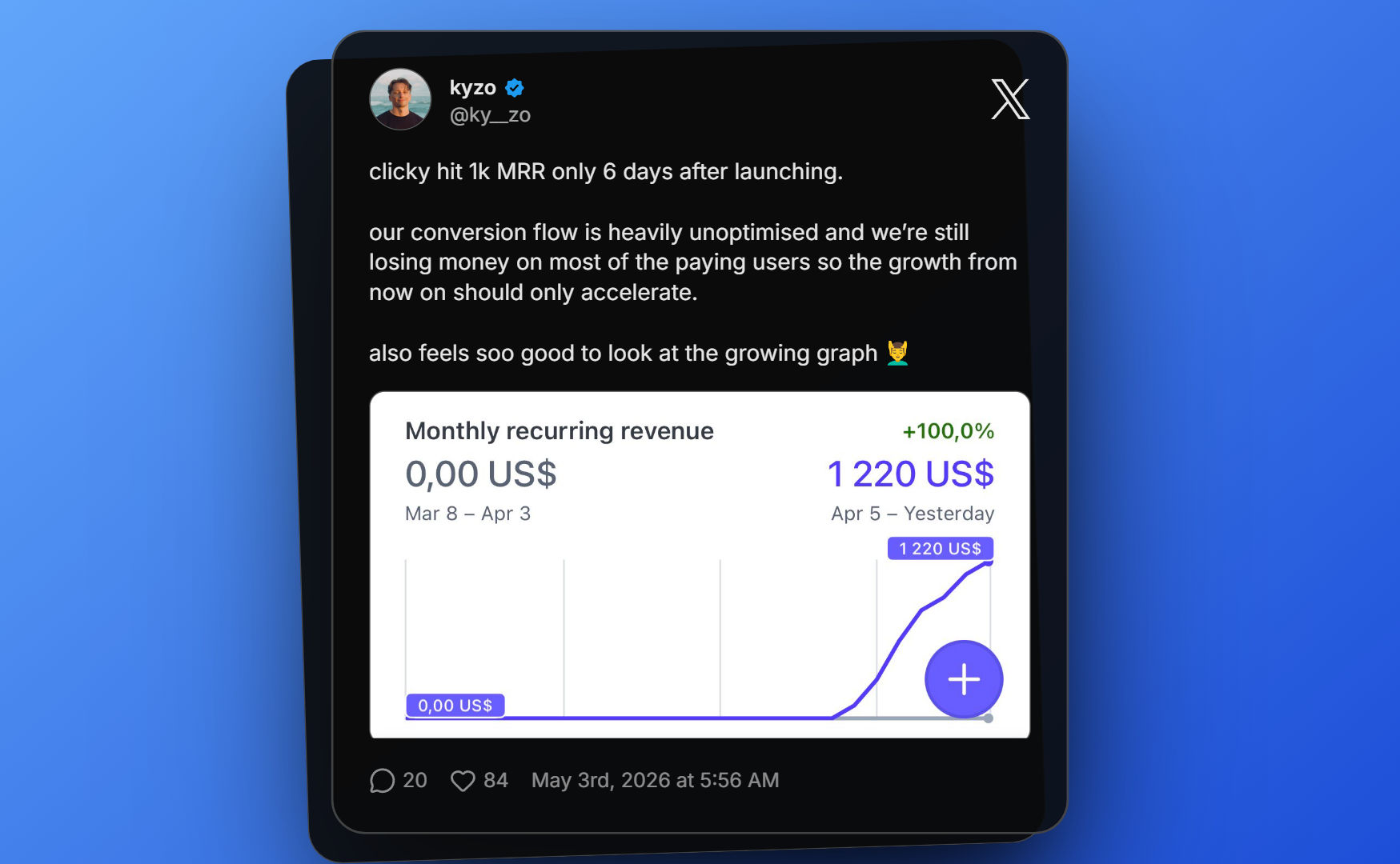
Just 6 days after launch, Clicky hit $1,000 MRR. Our conversion flow was completely unoptimized. Because of the heavy API costs (Claude, ElevenLabs, AssemblyAI), we were actually losing money on some of our early paying users. But in the hyper-growth phase, you are essentially "buying data and demand." Hitting $1K MRR in less than a week proved that putting an AI teacher directly inside the operating system is exactly what people want.
Through starting these businesses, have you learned anything particularly helpful?
1. Momentum is everything.
When Farza posted that demo, I didn't wait. I got on a flight to SF. Jump on hot ideas fast. Combine proven founder execution with frontier AI, and ship before perfection.
2. Open source as a marketing flywheel.
Open-sourcing Clicky's base code resulted in massive credibility. Developers became our evangelists. It proves you can build in public, give away immense value, and still build a highly profitable commercial layer on top of it.
3. Ship ugly, optimize later.
Clicky's funnel wasn't optimized. We launched it anyway. CopyCopter had scaling issues. I shipped it anyway. Even if unit economics are negative on day one, early revenue validates demand. You can optimize caching, cheaper models, and usage limits later.
4. Exits aren't the end; they fund the next sprint.
Selling MrScraper and CopyCopter didn't mean I was done. Those 5-figure micro-exits provided the mental and financial runway to spend 14 months building Fluar. Selling Fluar for 6-figures allowed me to drop everything and build Clicky.
5. You can just hack things.
If I can go from a depressed, burnt-out project manager to teaching myself to code in Bali and landing multiple acquisitions, anyone can. Stop over-engineering. Solve a problem, charge money, and iterate.
What platform/tools do you use for your business?
-
Cursor / Claude Code: Essential for solo-building and rapid iteration. We even included a
CLAUDE.mdin Clicky's open-source repo so others could easily fork and hack on it with AI. -
Swift & macOS Native tools: For building Clicky (NSPanels, OverlayWindow). I strongly believe the future of AI is native desktop.
-
Anthropic (Claude), ElevenLabs, AssemblyAI: The trifecta API stack that powers Clicky’s brain, voice, and ears.
-
Cloudflare Workers: Critical for securely proxying API keys in client-side/desktop applications.
-
Acquire.com: The absolute best marketplace for indie hackers to sell profitable micro-SaaS projects.
What does the future look like?
The graph for Clicky is accelerating. Our immediate focus is optimizing the conversion funnel to make unit economics profitable, shipping the highly-requested Windows version, and expanding what the desktop agents can do.
Beyond that, I am just enjoying the ride. The contrast between my life in early 2023 and today is insane.
My advice? The internet rewards speed and authenticity. Build tools that remove friction, share your journey openly, and don't be afraid to pull the plug if something isn't working. You're always just one weekend hackathon or one viral tweet away from changing your life.
Bottom Line
"You can just hack things. Don't wait for the perfect idea or the perfect tech stack ship ugly, chase the momentum, and let the market tell you what's valuable. The exits aren't the finish line; they're just the funding for your next crazy sprint." – Kamil Zowczak (Kyzo)
Disclaimer: This case study is research-based and has not been directly verified through an interview with the founder. Information was compiled from publicly available sources and is presented in an interview format for a better reading experience.