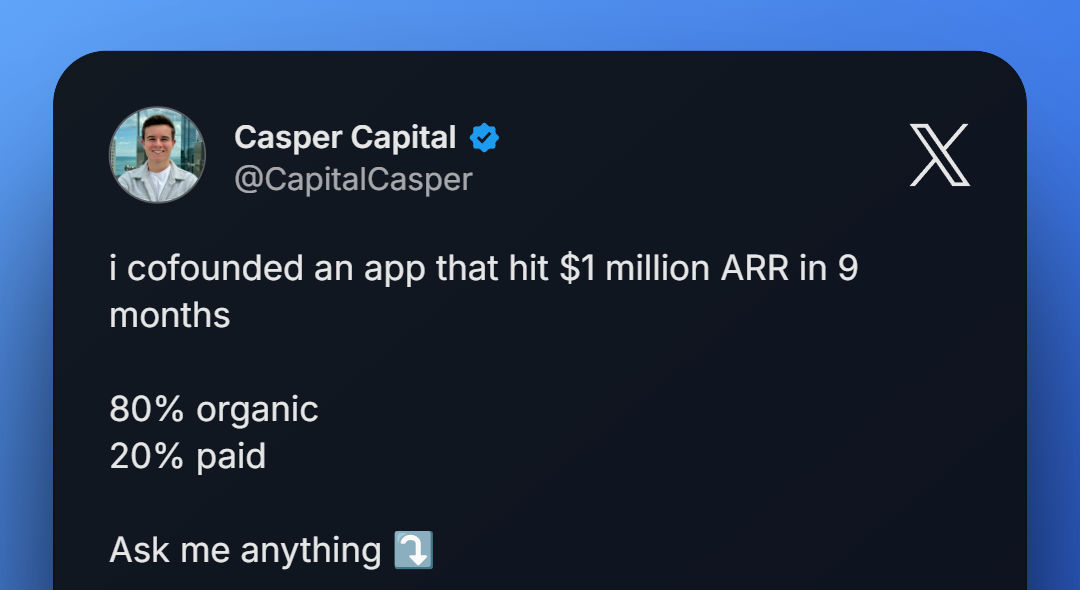
80% Organic. 20% Paid. $1M ARR in 9 Months. Here’s the System
 ## Hello! Who are you and what exactly are you building?
I'm Casper Opala (Casper Capital), a creator and growth hacker who spent four years building a personal finance audience of 10 million followers across YouTube, TikTok, and Instagram. Alongside my technical co-founder, Connor Burd, I build and scale creator-led startups.
My core thesis is simple: in today's app economy, distribution is outstripping development in value. It's never been easier to code an app, but it's never been harder to get eyeballs on it.
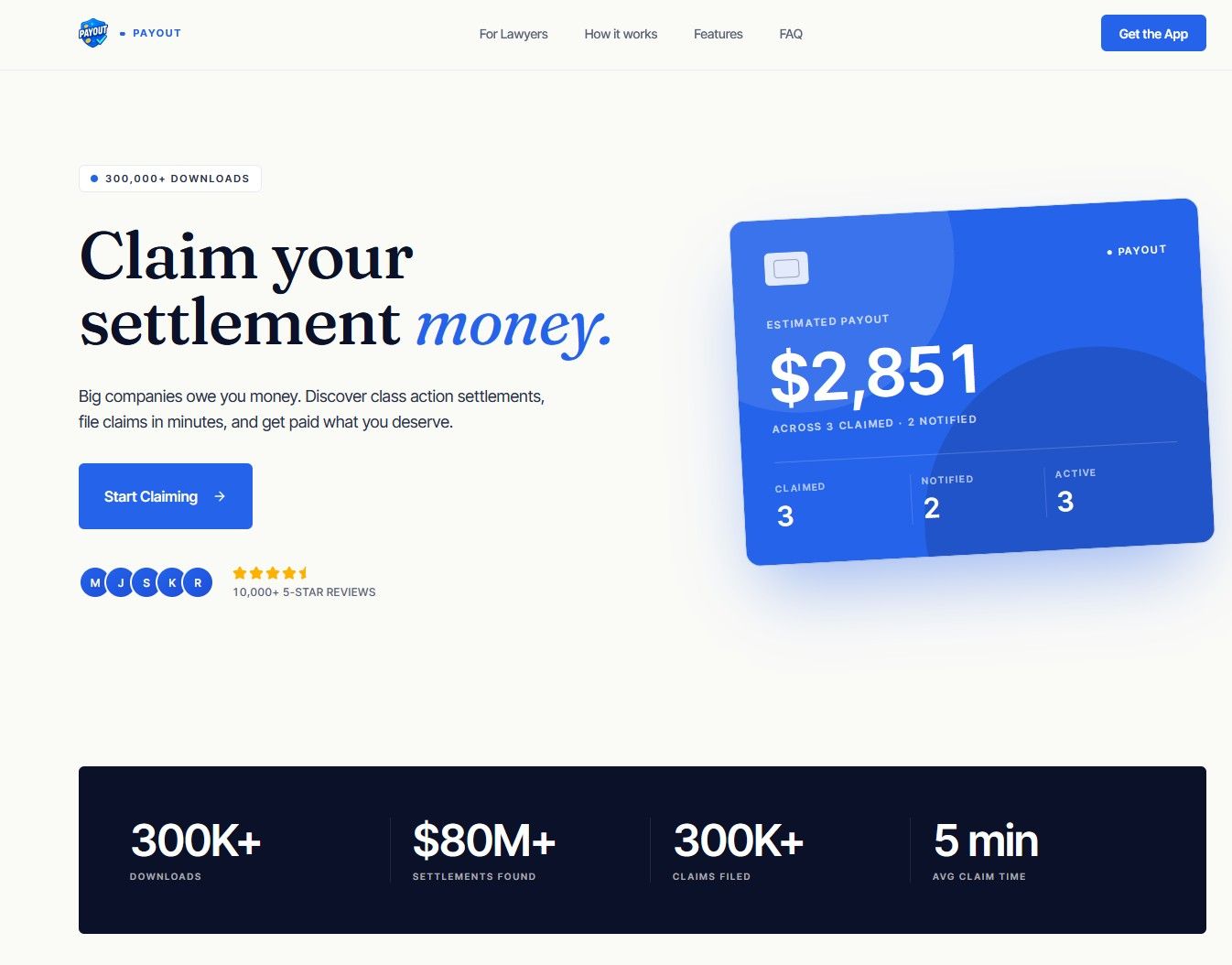
We partner directly with massive creators, build apps that their specific audiences want, and use organic short-form content to drive extreme download velocity. Our most notable success is the Payout app a mobile platform that helps everyday consumers discover and seamlessly file claims for corporate class action settlements (from data breaches to product issues).
 By turning a complicated, friction-heavy legal process into a simple, mobile side-hustle, we scaled to exactly $1,003,227 ARR (Annual Recurring Revenue) in just 9 months. I actually verified this by sharing our live dashboard during a Twitter/X AMA on May 2, 2026.
Casper Opala
Co-Founder · Payout
 United States
This story is compiled from public sources and presented in an interview format for a better reading experience.
What's your backstory and how did you come up with this model?
The idea didn't come from a "eureka" moment; it came from observing a fundamental market inefficiency.
I was watching A-list creators get bombarded with sponsorship offers from massive brands. I realized something: creators have unparalleled distribution, but they usually own zero equity in the products they push.
Instead of trying to scrape together $10k to pay a creator for a one-off shoutout, I changed the pitch. We built an app that specifically served the pain points of my finance audience leaving free settlement money on the table because the filing process is too clunky.
Connor and I partnered up because our skill sets were a perfect match: I had the 10M+ audience and the distribution engine, and Connor is a brilliant 23-year-old indie hacker with a track record of building high-revenue subscription apps. I handle the growth; he handles the product.
How We Built It (In 14 Days)
 Execution speed is everything. We didn't spend six months building a bloated MVP.
Connor "vibe coded" the initial version of Payout in roughly two weeks. He leveraged modern no-code/low-code tools and AI assistance, building the app on Expo (React Native) and Vercel. For monetization, we plugged right into RevenueCat to handle our in-app subscriptions.
Our startup costs were literally around $10. We matched users to brands they've purchased from, simplified the claim filing to under 5 minutes, and surfaced over $80M+ in available settlements. Because overhead is so low (we are a digital product guiding users, while the settlement admins handle the actual cash payouts), our margins are exceptionally high.
The "Stupid Simple" Strategy: 80% Organic, 20% Paid
 The traditional launch model is broken. Founders build an app, get 500 users, and slowly die because they can't afford customer acquisition costs (CAC). Here is exactly how we flipped the script.
1. The "Found Money" Psychology & 5-Minute Conversion
The primary barrier in legal tech is the cognitive load of paperwork and the fear of scams. We solved this with radical transparency and extreme UX simplification.
We explicitly market ourselves as a discovery platform, not a law firm. This shields us from legal liability and sets clear expectations. Once a user downloads the app, the core conversion mechanism is our 5-minute claim time. By reducing complex bureaucracy into a mobile-native questionnaire, we created a highly asymmetrical risk-reward proposition: spend 5 minutes on your phone for a chance at a $50 to $1,000+ payout.
2. The 80% Organic Engine (Our Moat)
Organic growth isn't passive; it’s an aggressively engineered system.
-
Public Building & AMAs: Hosting live AMAs and showing verified revenue dashboards builds unassailable trust. It tells the community, "This isn't a scam, it's a real business," which fuels algorithm-friendly engagement.
-
Contextual AI Engagement: We use automated systems and AI agents to monitor trending personal finance content on social media. We leave highly contextual, transparent comments under these videos. Curious users read the comment, check our profile, and click the bio link.
-
Dynamic Creator Payouts: We don't just pay creators a flat fee. We run performance models (often $1-$2 CPM on organic views). We also use dynamic, fractionalized payouts so both the creator who generated the top-of-funnel awareness and the affiliate who drove the final click get compensated. This keeps the whole creator ecosystem pushing our app.
3. The 20% Paid Strategy (Algorithmic Amplification)
We use paid ads surgically to stabilize the volatility of social media algorithms.
-
Apple Search Ads (ASA): This is our highest-intent traffic. People searching for "class action settlement" or "data breach claim app" have incredible retention rates.
-
Strict A/B Testing: We never launch sweeping changes to our paywall based on a guess. We use rigorous 80/20 or 90/10 traffic split testing to experiment with new onboarding flows or ad angles without risking our baseline revenue.
The Secret Sauce: How We Actually Make the Content Go Viral
This is where 99% of indie hackers fail. They get a creator to make a video, but it looks like an ad. Here are the exact psychological triggers we use to guarantee virality.
The #1 Rule: Never Say the App's Name Out Loud
This sounds counterintuitive, but it's our biggest lever. In our viral videos, the creator never says the name of the app.
If a creator says, "Go download Payout," the user opens the App Store, searches it, and the creator gets zero attribution. By keeping the name a secret, you force a curiosity gap. The user has to click the link in bio to find out what it is, guaranteeing flawless attribution and massive CTR.
The "Hook-to-Demo" Architecture
Our top-performing UGC videos follow a ruthless, high-velocity structure optimized for scroll retention:
-
The Hook (0-3 Seconds): Bypass legal jargon entirely. Introduce a relatable pain point or unbelievable premise (e.g., "Apple owes me $125 from a lawsuit, and it took me 5 minutes to claim it.").
-
The Demo (3-15 Seconds): Immediately cut to a screencast of the app. Show visual evidence of the seamless matching process to validate the hook.
-
The CTA (15-20 Seconds): A clear, unambiguous directive to hit the link in the bio.
Key Takeaways for Indie Hackers & Founders
-
Audience-First Beats Product-First: I didn't guess what my customers wanted; I spent four years talking to them. Build the audience (or partner with someone who has one), then build the product they are begging for.
-
Speed & Simplicity: Build in days, launch, and promote hard. Connor shipped Payout in 14 days by reducing a complex legal hurdle into a 5-minute flow.
-
The Equity Shift: Stop thinking your code is the most valuable part of the business. If you have no audience, give away equity to someone with millions of eyeballs.
-
Fractionalize Your Marketing: Don't just reward the last click. Use dynamic payouts to reward every creator in your funnel, and treat organic comments as high-value real estate.
Follow Casper's ongoing experiments and growth hacks on X: @CapitalCasper